
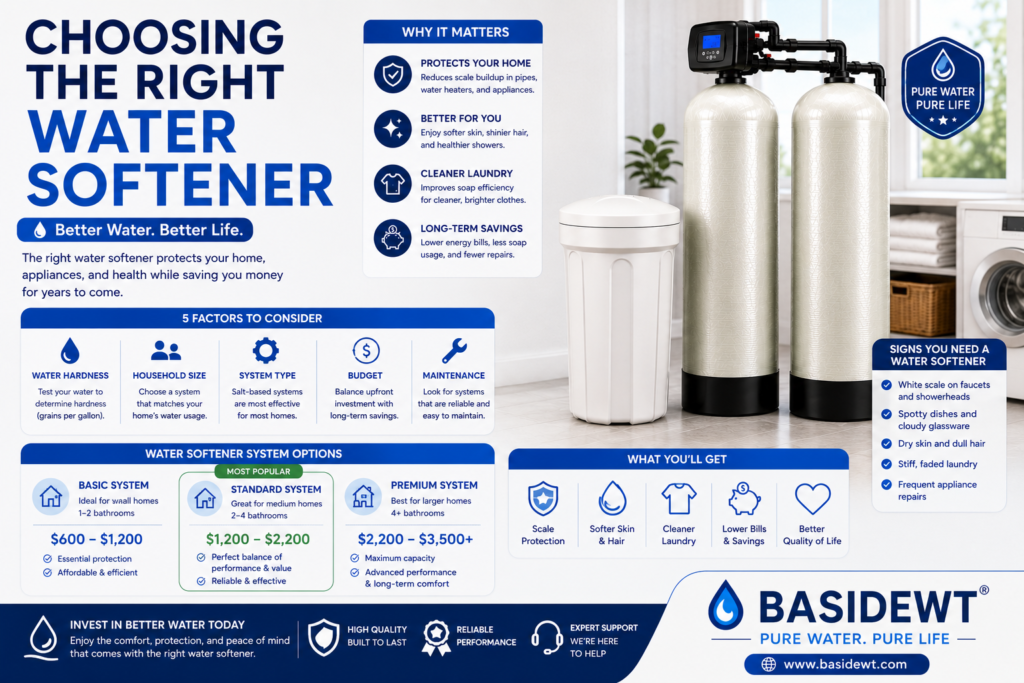
Hard water can create problems that become more noticeable over time. Mineral deposits around faucets, spots on dishes, soap residue in bathrooms, stiff laundry, and scale inside water-using appliances are common signs that a home’s water contains significant amounts of calcium and magnesium.
A water softener can help manage these minerals, but selecting a suitable system is not simply a matter of buying the biggest unit or choosing the lowest-priced option. Different homes have different water hardness levels, household sizes, consumption patterns, plumbing layouts, and maintenance requirements.
Choosing the right water softener starts with understanding those differences. By looking at water quality, system capacity, regeneration, installation, and long-term operating needs, homeowners can select a water softening solution that is practical for their property.
Start by Understanding Your Water Hardness
Before comparing water softener systems, determine how hard the home’s water actually is. Water hardness refers primarily to the concentration of dissolved calcium and magnesium.
Groundwater often becomes hard as it moves through mineral-rich rocks and soil. The level varies by location, which means two homes in different areas can have very different water-treatment requirements.
Water hardness is commonly measured in grains per gallon (GPG) or milligrams per liter (mg/L), expressed as calcium carbonate. Testing provides a much better starting point than guessing based on visible scale.
A water test may also reveal other characteristics of the water that could affect home water treatment. This is particularly useful for properties supplied by private wells, where water quality can vary depending on local groundwater conditions.
Hard water is not automatically an indication that drinking water is unsafe. Its main household effects are related to mineral scale, cleaning performance, plumbing fixtures, and water-using equipment.
Once the hardness level is known, homeowners can begin estimating how much softening capacity their household needs.
Consider Household Size and Water Consumption
Water usage is one of the most important factors in choosing a water softener. A system must be capable of treating the amount of water a household uses while also handling the hardness minerals contained in that water.
A small household with two occupants may use considerably less water than a family of five. Daily showers, laundry, dishwashing, cooking, and other activities all contribute to total consumption.
For example, imagine two houses with the same water hardness. The first is occupied by two adults who use moderate amounts of water. The second has several family members and regularly runs multiple loads of laundry and uses large amounts of water throughout the day. The second home will place a greater demand on its water softener.
Peak demand is worth considering as well. A system may need to supply several fixtures simultaneously without creating an unnecessary restriction in household water flow.
When comparing systems, homeowners should therefore consider:
- Number of people in the household
- Typical daily water consumption
- Water hardness level
- Peak water demand
- Available system capacity
- Expected regeneration frequency
These factors provide a more realistic basis for sizing than household size alone.
Understand Water Softener Capacity
Water softener capacity describes how much hardness a system can remove before regeneration is required. It is usually one of the most important specifications listed by manufacturers.
Capacity should always be considered alongside water hardness and household consumption. A system with a large capacity rating may not automatically be the best choice if the home’s actual water demand is modest.
An undersized unit can reach its capacity quickly and may need to regenerate more frequently. Frequent regeneration can increase salt and water consumption and may reduce the convenience of operating the system.
An excessively large system can also be inefficient from a purchasing perspective. Homeowners may pay for capacity they rarely need.
The goal is to select a system with enough capacity to handle normal household requirements while maintaining a sensible regeneration schedule.
Some manufacturers provide sizing recommendations based on hardness, daily water usage, and household size. These calculations can be useful when comparing different models because they connect the technical specifications to actual household conditions.
Capacity ratings should also be compared carefully because manufacturers may describe performance in different ways. Looking at the complete specification rather than one headline number can provide a clearer picture.
Learn How Different Softening Systems Operate
Most conventional water softeners use ion exchange. Inside the main tank are resin beads designed to attract calcium and magnesium ions.
As hard water passes through the resin, the hardness minerals are captured and exchanged for other ions. The treated water then moves into the home’s plumbing system.
Eventually, the resin becomes saturated with hardness minerals and must be regenerated. Salt-based systems use a concentrated brine solution to restore the resin’s ability to remove hardness.
Regeneration methods vary. Some systems operate on a fixed schedule, while others monitor water usage and initiate regeneration when the available capacity has been consumed.
Demand-initiated systems can be useful for households with changing water consumption because regeneration is based more closely on actual usage rather than an arbitrary schedule.
There are also different configurations and technologies available, so homeowners should evaluate how a particular system operates rather than assuming every water softener works in exactly the same way.
It is also important to distinguish water softening from broader residential water treatment. A softener is designed primarily to reduce hardness minerals. If a home has concerns involving sediment, iron, odors, or other water-quality characteristics, additional treatment may be appropriate depending on the results of testing.
For homeowners comparing system types, capacity, operation, and installation requirements, this choosing the right water softener resource can provide additional information to consider before making a final decision.
Evaluate Installation Requirements Before Buying
The best water softener on paper may not be the most practical choice if it does not suit the home’s plumbing layout or available installation space.
Most systems are installed near the point where water enters the property so that treated water can be distributed throughout the home. The installation area needs enough room for the main treatment tank, brine tank, controls, and associated plumbing.
A suitable drain connection is also necessary for systems that discharge wastewater during regeneration. Electrical access may be required for units with powered control valves.
Homeowners should also decide whether every water outlet needs softened water. In some properties, outdoor faucets and irrigation lines may not need to be connected to the softening system. Plumbing arrangements can sometimes be configured so that selected lines bypass treatment.
Existing plumbing can make installation relatively simple in one home and more involved in another. If significant modifications are required, getting advice from a qualified plumbing professional can help prevent problems caused by incorrect connections or inadequate drainage.
Installation planning should also leave enough access for future servicing. A system that is difficult to reach can make routine maintenance unnecessarily inconvenient.
Think About Maintenance and Long-Term Costs
Water softener maintenance is generally manageable, but homeowners should understand what ongoing care a system requires before purchasing it.
Salt-based systems need an adequate supply of regeneration salt. The brine tank should be checked periodically, particularly in households where water consumption changes throughout the year.
One issue that can occur is salt bridging. A hardened layer of salt can form inside the brine tank, making it appear full while preventing the system from using the salt properly. Regular inspection can help identify this type of problem before it affects normal operation.
Homeowners should also watch for leaks, unusual noises, changes in water quality, or signs that the system is no longer removing hardness effectively.
Maintenance requirements vary by equipment, so the manufacturer’s instructions should be followed for cleaning, inspections, component replacement, and servicing.
Operating expenses deserve attention as well. The overall cost of ownership can include salt, water used during regeneration, electricity where applicable, replacement components, and occasional professional service.
A system that costs less initially may not necessarily be the most economical option over its useful life. Looking at expected maintenance and operating requirements can help homeowners make a more balanced decision.
Match the System to Your Home’s Real Needs
Choosing a water softener becomes much easier when the decision is based on measurable conditions instead of appearance, advertising, or price alone.
Start by testing the water hardness and identifying any other relevant water-quality characteristics. Then estimate household consumption and consider periods of higher demand. Use this information to determine an appropriate water softener capacity.
Next, compare regeneration methods, installation requirements, controls, physical size, maintenance needs, and long-term operating costs. Consider the available installation area and make sure the system can be connected properly to the home’s plumbing and drainage.
It is also worth thinking about future household changes. A system that works well for a small household today may have different requirements if the number of occupants increases or water consumption changes substantially.
The purpose of a water softener for home use is not to provide the maximum possible capacity or the longest list of features. It is to provide an appropriate level of water softening for the property’s actual conditions.
A properly sized and maintained system can help reduce mineral scale and make everyday cleaning and household water use more manageable. The most reliable selection process is therefore straightforward: understand the water, estimate demand, choose suitable capacity, plan the installation carefully, and account for maintenance over the life of the equipment.
With those factors considered together, homeowners can make an informed choice and select a water softening system that fits both their household needs and their long-term expectations.