
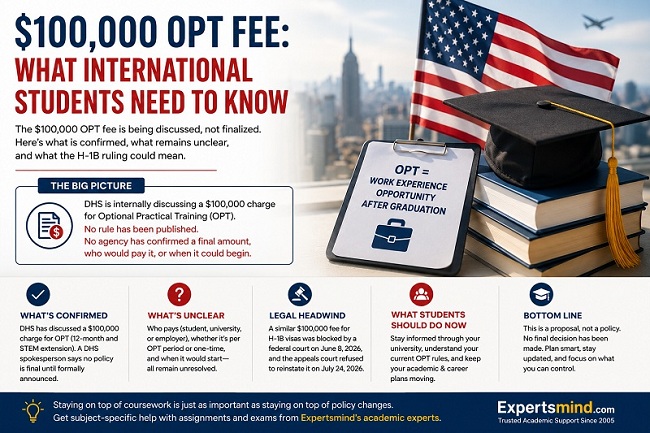
The $100,000 OPT fee is causing concern among international students, but there is an important distinction between a reported proposal and an actual immigration rule. According to the research paper, the Department of Homeland Security (DHS) is discussing a six-figure charge linked to Optional Practical Training, or OPT. No proposed rule has been published, and no agency has confirmed who would pay the fee or when it could begin.
That uncertainty matters. OPT is a major part of the financial calculation for students choosing a U.S. degree. International graduates can generally work for up to 12 months through regular OPT, while eligible STEM graduates can receive an additional 24-month extension. A major new cost could change how families assess tuition, living expenses and career prospects.
Why the OPT Proposal Matters So Much
OPT is more than a post-graduation benefit for many international students. It gives graduates a chance to gain U.S. work experience, earn a salary and potentially move toward longer-term employment sponsorship.
Consider a student who spends several years and a large amount of family savings on a U.S. engineering degree. The expected return is not simply the diploma. The student may also expect to work after graduation and recover part of that investment through employment. A $100,000 charge could dramatically alter that calculation.
That is why the reported proposal has generated attention even though it has no legal effect today. Students preparing applications for 2026 and 2027 need to distinguish between what has actually changed and what is still being discussed.
Students also need to keep their academic plans moving while following immigration developments. For help with different subjects, students can explore Expertsminds.com’s study subjects and academic resources rather than allowing policy uncertainty to derail coursework.
What Is Confirmed and What Is Still Unclear
The research paper separates the reported information from the unresolved questions. The key confirmed point is that DHS has reportedly discussed a $100,000 charge associated with OPT. However, this remains an internal discussion rather than a published regulation.
Several major questions remain unanswered. It is not clear whether the student, university or employer would pay. It is also unclear whether the charge would apply to each OPT period, a STEM extension, or through some other structure.
The timing is uncertain too. Reports suggest that DHS may be considering broader changes to OPT later in 2026, but no firm timetable has been established.
That distinction is easy to lose when a large number dominates the headlines. A reported proposal can create real anxiety without creating a legal obligation. Students should therefore avoid making major decisions based only on the $100,000 figure.
The H-1B Case Offers an Important Clue
There is another reason the OPT proposal deserves attention: the federal fight over a similar $100,000 H-1B fee.
The research paper notes that a $100,000 charge attached to certain new H-1B petitions in 2025 was challenged in federal court. On June 8, 2026, a Massachusetts federal judge vacated the policy, finding that Congress, rather than the executive branch, holds the authority to impose a fee of that scale.
The government appealed. On July 24, 2026, the First Circuit declined to pause the lower court’s ruling while the appeal continued. The appeals court did not settle the underlying legal dispute, but the decision left the H-1B fee blocked nationwide for the time being.
That history does not automatically invalidate a future OPT charge. The two policies are legally distinct. Still, it suggests that any major OPT fee could face serious legal scrutiny if DHS formally proposes it.
What Students Should Do Now
The smartest response is preparation, not panic. Students considering U.S. study should continue checking official information from their university’s international student office and DHS rather than treating social media posts or headlines as final policy.
Current students should also understand their existing OPT timelines and speak with their designated school official when questions arise. Confirmed immigration changes should be treated separately from proposals that have not yet entered the formal rulemaking process.
Academic performance matters during this period as well. Policy uncertainty can consume attention, but missed assignments and weak grades create immediate problems that are unrelated to any future immigration rule. Students who need assistance with coursework can also use Expertsmind homework help resources to stay on top of demanding academic work.
The wider message is equally important for prospective students. The United States remains a major study destination, but the post-graduation pathway is receiving closer policy attention. Canada, the UK and Australia may use that uncertainty to attract students who want clearer expectations after graduation.
The $100,000 OPT fee is therefore best understood as a warning signal, not a bill that students must pay today. The proposal could change, disappear, face legal challenges or eventually become a formal policy. Until there is an official rule, students should focus on verified information, keep their academic plans strong and build decisions around facts rather than headlines.
The clearest takeaway is simple: watch the rule, not the rumor.