
Source: https://blog.saferhome.ai/hurricane-hardening-upgrades-ranked
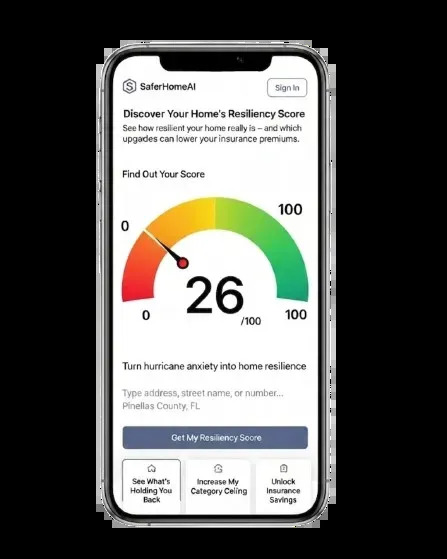
If you own a home on the Gulf Coast, you already know that insurance premiums keep climbing. The good news is that the right hurricane hardening upgrades in Florida can lower your wind premium every year. The bad news is that not every upgrade pays off equally.
This guide ranks the most common home hurricane upgrades in Pinellas County by cost, annual savings, and payback period, so you know where to spend first. If you want to reduce your premium quickly, the ranking below shows the best hurricane upgrade for insurance savings for different types of homes.
Note: Rankings reflect insurance-savings ROI, not safety alone. Safety matters independently, and your actual savings depend on your insurer, your home, and your current credits.
How Insurance Credits Work in Florida
Florida insurers apply discounts based on the features recorded in a wind mitigation inspection. The results are documented on the OIR-B1-1802 form, which scores five areas: roof covering, roof deck attachment, roof-to-wall connections, roof shape, and opening protection.
Two takeaways matter most:
- Opening protection and roof deck attachment carry the biggest credits.
- Insurers can’t apply credits for upgrades they don’t know about, so you must file a new inspection after any improvement.
The Ranked List of Hurricane Hardening Upgrades
1: Full Opening Protection (Impact Windows, Doors, and Skylights)
Installing impact windows and doors, or FBC-rated shutters, on every opening earns the largest single credit on the OIR-B1-1802 form: about 20–35% off the wind portion of your premium.
- Typical cost: 10,000–30,000
- Annual savings: 700–1,800
- Payback: 8–18 years, faster with a grant
The key word is every. One unprotected opening, including the garage door, lowers your classification. The My Safe Florida Home grant can match up to $10,000 of eligible costs, which shortens the payback period considerably.
2: New FBC-Compliant Roof System
A full re roof with 8d ring-shank nails and an FBC-rated covering improves four of the five OIR credit categories at once. It’s the highest total-value upgrade, especially for pre-2002 roofs.
- Typical cost: 15,000–35,000
- Annual savings: 800–2,500
- Payback: 10–22 years, faster if the roof needed replacing anyway
Book your wind mitigation inspection right after the job while your contractor’s documentation is still on hand. Many homeowners skip this step and keep paying old rates for years.
3: Wind-Rated Garage Door (Fastest Payback)
Garage door hurricane reinforcement in Florida is often the cheapest way to complete your opening protection. Many Pinellas homes have impact windows but a standard garage door, and that one gap can block the top credit.
- Typical cost: 1,500–4,000
- Potential annual savings: 500–1,500
- Payback: 1–4 years
This only pays off if the garage door is the only unprotected opening. Confirm that before you buy.
4: Hip Roof Conversion
A hip roof insurance discount in Florida typically runs 10–20% of the wind premium, because hip roofs earn the maximum roof-shape credit while gable roofs earn none. Conversion makes sense only during a planned reroofing, and only if your framing allows it.
- Added cost: 3,000–8,000 over a standard gable reroof
- Annual savings: 350–700
- Payback: 6–15 years on the added cost
5: Roof-to-Wall Connection Upgrade
Homes built before 2002 often have toe-nail connections, which earn zero credit. A roof-to-wall connection upgrade to clips, wraps, or structural anchors is done from the attic and can be completed without a full reroof.
- Typical cost: 1,000–5,000
- Annual savings: 200–600
- Payback: 5–15 years
It’s also structurally significant, since connection failure is a leading cause of total roof loss in hurricanes.
6: Secondary Water Resistance (SWR)
Secondary water resistance is a sealed peel-and-stick layer over the roof deck. The insurance savings are modest (100–350 a year), but adding it during a reroof costs only 500–2,000 more, and it can prevent major interior water damage. It’s also required for a FORTIFIED Roof.
Bonus: FORTIFIED Home Certification
FORTIFIED Home certification, a voluntary IBHS standard that exceeds the Florida Building Code, comes in three tiers: Roof, Silver, and Gold. It can unlock credits beyond standard OIR maximums and qualifies you for grant programs. Combining a FORTIFIED Roof with full opening protection gives you FORTIFIED Silver.
Which Upgrade Should You Do First?
| Your situation | Start with |
| Impact windows, but a standard garage door | Wind-rated garage door (#3) |
| No opening protection at all | Full opening protection (#1) plus a grant application |
| Aging roof (15+ years, pre-2002) | New roof system (#2), and price a hip conversion |
| Recently reroofed, never re-inspected | Book a wind mitigation inspection now |
| Want maximum long-term protection | FORTIFIED Roof plus full opening protection |
Don’t Skip the Inspection
Whatever you upgrade, the savings only appear once your insurer sees updated documentation. A wind mitigation inspection costs roughly 100–150, while the hurricane hardening upgrades’ insurance savings in FL it documents can exceed $1,000 a year. It’s the cheapest step on this whole list.
Frequently Asked Questions
What is the best hurricane upgrade for insurance savings in Florida?
Full opening protection earns the biggest credit, typically 20–35% off your wind premium. If your only gap is the garage door, replacing it is usually the fastest payback.
How much does a hip roof save on insurance in Florida?
Typically 10–20% of the wind premium, or roughly 350–700 a year on a $3,500 wind premium.
Does a wind-rated garage door lower my premium?
Yes, if it completes full opening protection, with potential savings of 500–1,500 a year.
Do I need a new inspection after upgrades?
Yes. Without an updated wind mitigation inspection, your insurer can’t apply the new credits.
Take the Next Step
Instead of guessing, get a free fortification score for your home. It maps your current features against each upgrade above and estimates the savings from each.