
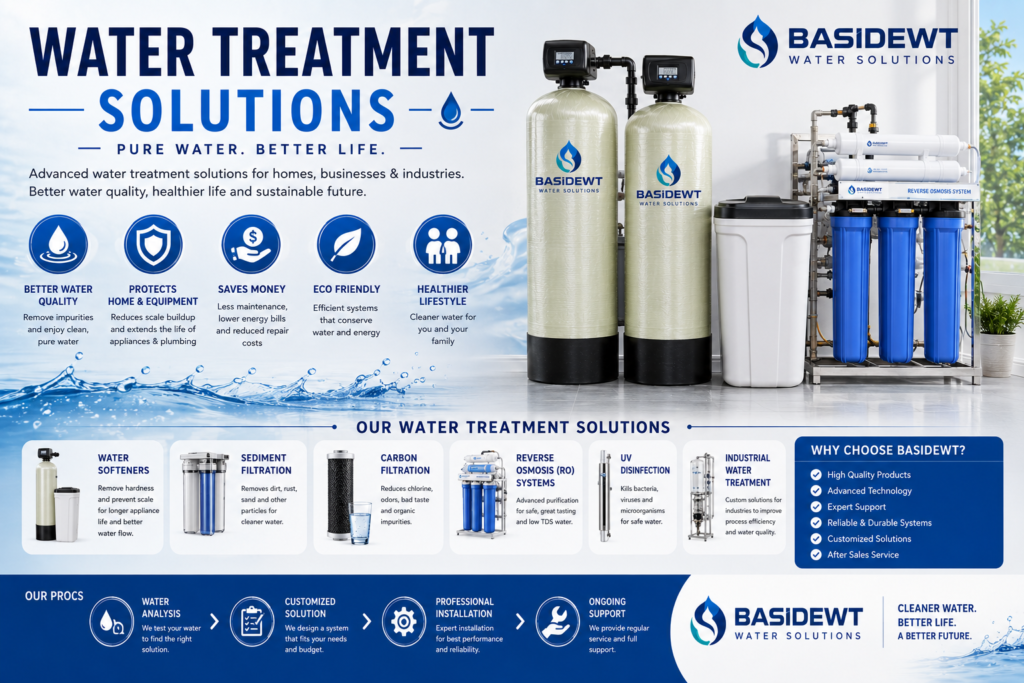
Water quality plays an important role in the everyday operation of a home. From drinking and cooking to bathing, laundry, and cleaning, households rely on water for countless tasks. Yet water can contain minerals and other substances that affect how it looks, tastes, feels, or behaves inside plumbing and appliances.
The right water treatment solutions depend on the specific characteristics of the water and the goals of the household. Hard water, for example, requires a different approach from sediment, unpleasant odors, or other water-quality concerns. Understanding the problem before selecting equipment can help homeowners avoid unnecessary treatment and choose a system that fits their property.
A thoughtful approach to water treatment solutions starts with testing the water, identifying the source of the problem, and then selecting equipment based on actual household requirements.
Understanding the Most Common Household Water Problems
Water quality can vary significantly depending on the local supply, groundwater conditions, plumbing, and treatment already provided by a municipal utility. Before purchasing equipment, homeowners should identify the specific issue they want to address.
Hard water is one of the most common concerns. It contains dissolved calcium and magnesium, which can leave mineral deposits on faucets, shower doors, sinks, and dishes. Over time, these minerals can contribute to scale inside plumbing and water-using appliances.
Sediment is another possible concern, particularly in properties supplied by private wells. Sand, silt, or other suspended particles can affect water appearance and may interfere with certain plumbing components.
Some homes may also experience unpleasant taste or odor. In such cases, filtration technologies may be more appropriate than a conventional softener.
The important point is that no single treatment method is designed to solve every possible water-quality issue. Effective water treatment solutions begin with understanding what is actually present in the water.
A laboratory or appropriate home water test can provide useful information. Testing is especially valuable for well owners because groundwater conditions can differ from one property to another.
How Water Softeners Address Hard Water
When hardness is the primary concern, a conventional water softener may be an appropriate treatment option. Most traditional systems use ion exchange to reduce calcium and magnesium.
The system contains a tank filled with resin beads. As hard water passes through the resin, calcium and magnesium ions are attracted to the resin and removed from the water. Sodium ions, or potassium in some systems, are released in their place.
Eventually, the resin becomes saturated with hardness minerals. It then needs to be regenerated. During this cycle, a brine solution passes through the resin and helps remove the accumulated minerals. The resin is subsequently rinsed and prepared for another treatment cycle.
This process differs from ordinary filtration. A sediment filter is designed to capture suspended particles, while a carbon filter may address certain taste, odor, or chemical concerns. Water softening specifically targets hardness minerals.
There are also salt-free conditioning systems that use different methods to reduce scale formation. These systems should be evaluated according to their technology and the homeowner’s objective rather than being treated as identical to conventional ion-exchange softeners.
Understanding the treatment process makes it easier to compare water treatment solutions based on what they are actually designed to accomplish.
Test Water Hardness Before Selecting Equipment
Water hardness is one of the most important factors when selecting a water softener. It is commonly measured in grains per gallon (GPG) or milligrams per liter (mg/L), expressed as calcium carbonate.
Simply seeing white deposits around a faucet does not reveal the exact hardness level. A water test provides a much better basis for selecting treatment equipment.
The source of the water should also be considered. Municipal supplies may have relatively consistent characteristics, while private wells can vary according to local geology and groundwater conditions.
Well water may contain hardness alongside iron, manganese, sediment, or other substances. If these characteristics are present, a softener alone may not provide comprehensive treatment. Additional filtration or conditioning may be needed depending on the test results.
Homeowners should therefore avoid choosing equipment solely because a particular system is advertised as suitable for “hard water.” The actual hardness level and other water characteristics are more useful when determining what type and size of equipment are appropriate.
For readers who want a more detailed explanation of softener sizing and purchasing considerations, this water softener guide provides additional information that can help with the decision-making process.
Match System Capacity to Household Water Use
Water softener capacity is another important consideration. Capacity is typically expressed in grains and indicates how much hardness a system can handle under specified operating conditions.
A system should be sized according to both water hardness and household consumption. A small household with moderate water use will generally have different requirements from a large family using several bathrooms and running frequent laundry cycles.
For example, imagine two homes with similar water hardness. One has two occupants and relatively modest water consumption. The other has six occupants and regular visitors. The second property will normally place a greater demand on its softener.
Choosing a system with insufficient capacity may result in more frequent regeneration. Selecting a system that is substantially larger than necessary can increase the purchase price without necessarily improving the household’s results.
Capacity ratings should also be examined carefully because manufacturers may specify performance at different salt settings. The highest advertised capacity is not necessarily the capacity a household will obtain under normal operating conditions.
When comparing water treatment solutions, homeowners should therefore consider actual household demand rather than selecting equipment solely by its maximum rated capacity.
Consider Regeneration, Efficiency, and Operating Costs
Regeneration is an important part of traditional water softener operation. Some systems regenerate according to a preset schedule, while demand-initiated models use water consumption information to determine when regeneration is necessary.
A demand-based system can be useful for households where water use changes. A home may consume more water when guests stay over, for example, and less during periods when residents are away.
Salt consumption is another operating consideration. The amount required depends on water hardness, household demand, system design, and programmed settings. More salt does not automatically mean better treatment.
Water used during regeneration should also be considered. Frequent regeneration can increase water consumption, particularly when a system is not appropriately sized or configured.
The purchase price is only one part of the total cost of ownership. Homeowners should consider salt, water, electricity, replacement components, servicing, and installation when comparing different systems.
A moderately priced system that is correctly sized and efficiently operated may be more practical than an inexpensive unit that regenerates unnecessarily often. Likewise, an advanced system may not provide meaningful additional value if its extra features are unnecessary for the household.
Plan Installation Around the Home’s Plumbing
Installation requirements should be considered before purchasing treatment equipment. A suitable system needs enough space, appropriate plumbing connections, and access for maintenance.
Traditional softeners commonly consist of a resin tank and a separate brine tank. Both components require adequate floor space, and the brine tank should remain accessible for adding salt.
A suitable drain connection is generally required for regeneration wastewater. Many systems also need an electrical outlet for their control valve and programming system.
The installation area should be protected from freezing temperatures and excessive heat. There should also be enough clearance around the equipment for inspection and servicing.
The home’s plumbing layout can influence the design of the installation. Some homeowners may want softened water throughout the indoor plumbing while leaving outdoor hose connections or irrigation lines untreated.
Older properties may require plumbing modifications before a treatment system can be installed. If the work involves changes to the main supply line or complicated connections, professional installation can help ensure that the equipment is integrated correctly.
Planning these details before purchasing prevents an otherwise suitable system from becoming difficult to install.
Maintain Treatment Equipment for Reliable Performance
Even well-designed water treatment solutions require appropriate maintenance. Regular care helps keep equipment operating consistently and can reveal potential problems before they become more serious.
For salt-based softeners, homeowners should monitor the brine tank and maintain an adequate supply of salt. The tank can occasionally develop a salt bridge, where hardened salt forms a layer that prevents proper brine formation.
The system should also be inspected for leaks, unusual sounds, warning messages, and changes in performance. If hard-water symptoms begin returning, possible causes include incorrect settings, insufficient capacity, a mechanical problem, or changes in the incoming water.
Following the manufacturer’s maintenance recommendations is important because different systems have different service requirements. Some equipment may include automated monitoring, while simpler units may require more manual attention.
Homeowners should also consider replacement parts and service availability when choosing equipment. A system that can be maintained easily may be more convenient over its useful life than one that depends on difficult-to-source components.
Choosing a Complete Home Water Treatment Strategy
The best water treatment solutions are based on the actual water-quality problems found at a property. Rather than purchasing equipment based on a single symptom, homeowners should consider the complete water picture.
Start with testing. Determine the hardness level and identify whether other characteristics, such as sediment, iron, or taste and odor concerns, require attention. Then select treatment equipment according to those findings.
For hard water, an appropriately sized softener may be the central component of the treatment strategy. Other water concerns may require filtration or additional treatment stages.
Household demand should then be considered. The number of residents, water-use patterns, plumbing configuration, and available installation space all influence equipment selection.
Maintenance and operating costs should remain part of the decision as well. A treatment system is a long-term household investment, so homeowners should understand what will be required after installation.
Ultimately, effective water treatment solutions do not depend on choosing the largest or most expensive equipment. They depend on identifying the actual water problem, selecting technology designed for that problem, sizing the equipment correctly, and maintaining it according to the manufacturer’s requirements.
With reliable water testing and careful planning, homeowners can create a practical residential water treatment approach that addresses hard water and other concerns without unnecessary equipment or complexity.