
Every screenwriter has experienced the same sinking feeling. You finish a draft, read it through, and know something is wrong. The story feels off, but you cannot pinpoint why. The beginning seems fine. The ending works. But somewhere in the middle, the energy drains away. Scenes that should crackle with tension feel flat. Moments that should fly by instead drag. You have a structural problem and a pacing problem, and they are tangled together like wires behind a television.
This is where screenplay analysis becomes indispensable. Unlike general feedback from friends or writing groups, professional screenplay analysis is a systematic examination of how a script is built. It looks at the skeleton of your story, the acts, the beats, the turning points and evaluates whether that skeleton supports the weight of your narrative. It examines the rhythm of your scenes, the distribution of tension and release, and the momentum that carries a reader from page one to page 120.
For writers serious about improvement, screenplay analysis is not a luxury. It is a tool as essential as formatting software or a keyboard. This article explores exactly how screenplay analysis transforms two of the most elusive elements of craft: structure and pacing. By understanding what professional analysts look for, you will learn to diagnose and fix these problems in your own work, turning a sluggish, shapeless draft into a taut, propulsive screenplay.
What Is Screenplay Analysis?
Screenplay analysis is the practice of evaluating a script against industry standards for narrative construction. While a friend might say, “I got bored in the middle,” a professional analyst will tell you exactly where you lost them and why. The analysis focuses on measurable, teachable elements of craft rather than subjective taste.
A professional screenplay analysis typically covers:
- – Structural breakdown: Where are the act breaks? Does the inciting incident land at the right moment? Is the midpoint a true game-changer?
- – Scene-level pacing: How long does each scene run? Are similar-length scenes creating monotony?
- – Tension arcs: Does each scene have a clear objective, obstacle, and outcome? Does conflict escalate or dissipate?
- – Page economy: Are there redundant scenes? Do action paragraphs breathe properly?
- – Rhythm and flow: How does the script balance dialogue, action, and silence?
Unlike coverage (which recommends Pass, Consider, or Recommend), analysis is purely developmental. Its goal is not to judge your script’s commercial potential. Its goal is to give you the tools to make your script better. For writers stuck on a problematic draft, analysis provides the roadmap forward.
The Anatomy of Story Structure
Before understanding how analysis improves structure, you must understand what structure actually is. Structure is the deliberate arrangement of story events to create emotional impact. It is not a rigid formula, despite what some screenwriting gurus claim. But successful screenplays, regardless of genre or style, share common structural DNA.
The Classic Three-Act Framework
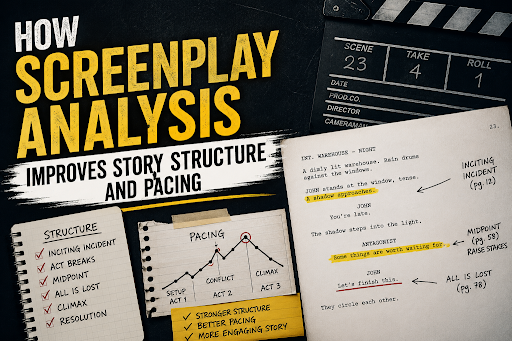
Most commercial screenplays follow some variation of three-act structure. Act one establishes the world and the protagonist. Act two complicates the protagonist’s pursuit of their goal. Act three resolves the conflict. Within this framework, specific beats must land at specific page ranges to maintain audience engagement.
Screenplay analysis evaluates each of these beats.
The Opening Image (Pages 1-5)
The first pages establish tone, genre, and protagonist. Analysis will ask: Does the opening hook the reader? Does it establish what is ordinary about the protagonist’s world before it is disrupted? Or does it start too slowly, with a setup that feels like waiting for the story to begin?
The Inciting Incident (Pages 10-15)
This is the event that disrupts the protagonist’s normal life and creates a question the audience wants answered. Analysis will identify exactly where your inciting incident occurs. Too early, and the audience has no context to care. Too late, and they have stopped reading. The analyst will also evaluate whether the inciting incident is truly an event (something that happens) or merely a conversation (something that is discussed).
First Act Break (Pages 25-30)
The protagonist commits to the journey. They leave their ordinary world and enter the adventure. Analysis will assess whether this commitment feels earned and irrevocable. Does the protagonist have a clear goal? Are the stakes personal and urgent? Or does the script drift into act two without a decisive turning point?
The Second Act Complication
Act two is where most scripts die. Analysis will examine whether your second act contains escalating obstacles, new information, and deepening character revelation. It will identify the midpoint (page 55-60) where the stakes should raise dramatically. It will flag the “all is lost” moment (page 75-85) where the protagonist appears defeated. And it will evaluate the second act break (page 85-90) where the protagonist gathers resources for the final confrontation.
Third Act Climax and Resolution
The climax is the final confrontation between protagonist and antagonist. Analysis will evaluate whether this confrontation flows logically from earlier events or arrives as a surprise that feels unearned. It will assess whether the resolution answers the story’s central question and delivers emotional catharsis. It will also check for the “false ending” , a common amateur mistake where the script resolves, then continues for another ten pages.
How Analysis Diagnoses Structural Problems
Professional screenplay analysis does not just list structural beats. It identifies specific failures and explains their consequences.
The Missing Inciting Incident
If your inciting incident is missing or weak, analysis will note: “Pages 1-20 establish character but no clear disruption occurs. The protagonist remains in a static situation. Consider introducing an event on page 12 that forces a choice.” This note tells you exactly what is missing and where to put it.
The Sagging Middle
If act two loses momentum, analysis will pinpoint the page range: “Pages 45-65 repeat the same obstacle without escalation. The protagonist overcomes problem A, then problem B, then problem C, but none of these problems change the protagonist or raise the stakes. Consider consolidating these scenes and introducing a twist that reveals new information about the antagonist.”
The Confused Midpoint
If your midpoint does not function properly, analysis will explain: “Page 58 features a chase sequence, but the protagonist’s goal and the nature of the opposition remain unchanged afterward. A true midpoint should either reveal hidden information (the mentor is working for the villain) or escalate the stakes (the villain now threatens someone the protagonist loves).”
The Premature Climax
If your climax occurs too early, analysis will flag: “The antagonist is defeated on page 92, but the script continues for another 25 pages. The remaining material consists of falling action without new tension. Consider moving the climax later or introducing a final twist that re-escalates stakes.”
These specific diagnoses transform vague frustration into actionable revision plans. You no longer wonder why act two feels slow. You know exactly which pages to rewrite and what to add.
Understanding Pacing
If structure is the skeleton of your screenplay, pacing is its heartbeat. Pacing is the rate at which information, emotion, and action are delivered to the audience. A script with good pacing feels effortless to read. Tension builds, releases, and builds again in a rhythm that feels organic. A script with poor pacing feels exhausting (too much tension without release) or boring (not enough tension at all).
Screenplay analysis evaluates pacing at multiple levels.
Scene-Level Pacing
Each scene should have a micro-structure: a beginning that establishes a character objective, a middle where obstacles arise, and an end where the outcome changes the character’s situation. Analysis will evaluate whether your scenes contain conflict and change. Scenes where characters talk without wanting anything, or where nothing changes from the first line to the last, are pacing killers.
The analyst will also note scene length variation. If every scene is exactly two pages, the rhythm becomes monotonous. A three-page scene followed by a half-page scene followed by a five-page scene creates a dynamic reading experience. Analysis will flag when your scene lengths are too uniform.
Sequence-Level Pacing
Groups of scenes form sequences. A chase sequence might contain five short scenes. A romantic sequence might contain three longer, dialogue-heavy scenes. Analysis will evaluate whether your sequences vary in intensity and duration. Too many high-intensity sequences in a row exhaust the reader. Too many low-intensity sequences in a row bore them.
Act-Level Pacing
Each act should have its own pacing signature. Act one is typically slower, establishing character and world. Act two accelerates, with obstacles arriving faster. Act three is fastest, with cause and effect tightening until the climax. Analysis will assess whether your act pacing follows this arc or whether act one is too fast (no setup) or act three is too slow (lingering after the climax).
Common Pacing Problems and How Analysis Catches Them
Professional screenplay analysis has seen every pacing problem imaginable. Here are the most common and how analysts identify them.
The Slow Opening
The script spends ten pages on backstory, childhood memories, or daily routines before anything interesting happens. Analysis will note: “The first ten pages contain no inciting incident. The protagonist wakes up, showers, goes to work, and talks to colleagues about nothing that advances plot or character. Cut to page 8 where the first meaningful event occurs.”
The Rush Job
The script accelerates so quickly that the audience never bonds with the protagonist. Analysis will note: “The inciting incident occurs on page 3, but we do not know who the protagonist is or why we should care. Consider adding two to three pages of establishing scenes that reveal character through action before the disruption.”
The Endless Middle
Act two contains fifteen scenes that all feel identical. The protagonist encounters an obstacle, overcomes it, encounters another obstacle, overcomes it. Analysis will note: “Pages 30 to 70 lack escalation. The obstacles do not become more difficult or personal. Each scene resets to zero rather than building on what came before. Consider introducing a ticking clock (time limit) or raising the antagonist’s threat level at the midpoint.”
The Interrogation Scene
A common amateur pacing error is the long scene where one character explains information to another. Analysis will note: “Pages 52-58 consist of Character A telling Character B the backstory. This is pure exposition with no conflict. Consider revealing this information through action or during an argument where characters have opposing goals.”
The Hanging Ending
The climax resolves, but the script continues for ten pages of characters explaining how they feel about what just happened. Analysis will note: “The story ends on page 98, but the script runs to page 110. The final twelve pages are denouement without new tension. A great screenplay gets out early. Cut to page 102.”
How Analysis Measures Page Economy
Page economy is the principle that every page should earn its place. Redundant scenes, repetitive dialogue, and over-described action all waste pages and kill pacing. Screenplay analysis evaluates page economy ruthlessly.
Redundant Scenes
Two scenes that accomplish the same narrative purpose should be consolidated. Analysis will identify: “Scenes 12 and 14 both show the protagonist being rejected by a love interest. The second rejection does not reveal new information or change the relationship. Cut scene 14 or combine its best elements into scene 12.”
On-the-Nose Dialogue
When characters say exactly what they mean, dialogue expands to fill pages without creating tension. Analysis will flag on-the-nose exchanges and suggest subtext alternatives: “On page 34, the protagonist says ‘I am angry because you lied to me.’ Consider instead: ‘You said you would be there.’ The second line implies anger and betrayal without stating it, saving half a page while adding depth.”
Overwritten Action
Dense action paragraphs slow reading speed. Analysis will note: “Page 78 contains a 12-line action paragraph describing a car chase. Break this into shorter, punchier lines. White space accelerates pacing. Dense text slows it.”
Dialogue Overload
Pages of uninterrupted dialogue, even good dialogue, create a stage-play feel that drags on screen. Analysis will note: “Pages 40-45 are a single conversation in a single location. Consider breaking this into shorter scenes, adding physical action, or cutting the least essential exchanges by half.”
The Relationship Between Structure and Pacing
Structure and pacing are not separate concerns. They are deeply intertwined. A structural problem often manifests as a pacing problem. A missing midpoint does not just break structure; it creates a sagging second act where nothing important happens for twenty pages. A misplaced inciting incident does not just break structure; it creates a slow opening where the reader waits for the story to start.
Screenplay analysis understands this relationship. A good analysis will show you how fixing a structural element moving the midpoint earlier, adding a turning point automatically improves pacing. You are not making two separate fixes. You are making one fix that solves two problems.
For example, if analysis identifies that your protagonist is too passive (a structural character problem), the recommended fix might be adding a scene where the protagonist makes an active, difficult choice. That new scene adds a turning point that also improves pacing by breaking up a flat stretch of reactive scenes. Structure and pacing improve together.
Using Analysis Feedback Effectively
Receiving a screenplay analysis can feel overwhelming. A detailed report might contain twenty or thirty observations, from major structural flaws to line-level pacing tweaks. Do not try to fix everything at once.
Prioritize structural issues first. A broken act two makes pacing fixes meaningless. Fix the skeleton before you worry about the heartbeat.
Next, address scene-level pacing. Identify the scenes that analysis flagged as too long, too short, or lacking conflict. Revise them individually.
Finally, polish line-level issues: action paragraph density, dialogue subtext, transitional economy.
Resist the urge to argue with the analysis. You will disagree with some observations. That is fine. You are the writer; you make the final call. But before dismissing a note, ask yourself: Is this note wrong, or is it uncomfortable? Many writers reject accurate criticism because it hurts to hear. If you are unsure, set the note aside for a week. Return to it with fresh eyes. Often, the note that stung most is the one you eventually realize is correct.
When to Seek Screenplay Analysis
Not every draft needs professional analysis. Use analysis at specific moments in your writing process.
After Your Third or Fourth Draft
By this point, you have addressed obvious problems. Peer feedback has been incorporated. You have taken the script as far as you can alone. Now professional analysis can identify the subtle structural and pacing issues you cannot see.
Before Major Submissions
If you are entering competitions, querying agents, or submitting to fellowships, invest in analysis first. A competition reader will not tell you why they rejected your script. A professional analyst will. Use that feedback to improve before submission.
When You Are Stuck
If you have rewritten the same script six times and it still does not work, you have lost perspective. Professional analysis provides an external, expert perspective that can break the logjam. The analyst will see patterns you have become blind to.
Between Projects
After finishing a script, before starting the next, seek analysis on the completed work. Treat it as a learning tool. Understanding what worked and what did not in one script makes you a better writer in the next.
Choosing a Screenplay Analysis Service
Look for analysts with professional credentials: former studio readers, development executives, or produced screenwriters. Avoid services that use anonymous readers with unverifiable experience. Ask for sample analyses before purchasing. A good sample will be specific, actionable, and respectful.
Expect to pay between $150 and $400 for a feature-length analysis. Turnaround of 5 to 10 business days is standard. Faster turnaround often means less thoughtful analysis.
The Long-Term Benefit
Beyond improving a single script, learning to think like an analyst transforms your writing process. You will begin to self-diagnose structural problems as you outline. You will feel pacing issues during your first draft and adjust before you finish. You will develop an internal editor that catches the problems that used to require outside help.
Writers who internalize screenplay analysis principles write better first drafts, complete faster revisions, and submit scripts with greater confidence. The analysis you pay for today teaches you skills you use for every script you write for the rest of your career.