
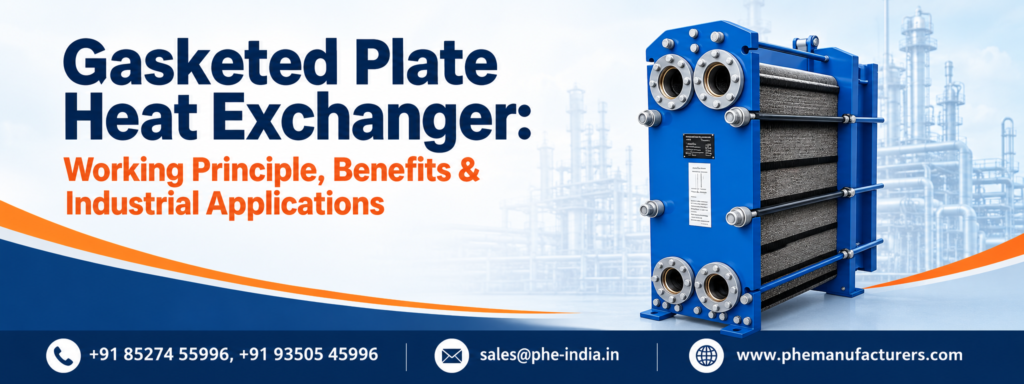
Efficient heat transfer sits at the core of countless industrial processes. Whether it’s maintaining a precise reaction temperature in a chemical plant, cooling hydraulic oil in heavy machinery, or managing chilled water in an HVAC system, industries rely on equipment that can move heat between fluids reliably, safely, and without excessive energy loss.
As process demands grow more complex, industries increasingly need heating and cooling systems that offer consistent performance while keeping operating costs and installation space in check. This is where the Gasketed Plate Heat Exchanger has become a widely used solution — valued for its compact footprint and efficient heat-transfer design across a broad range of industrial applications.
This article explains what a gasketed plate heat exchanger is, how it works, its main benefits, and the factors engineers and procurement teams should consider when selecting one.
What Is a Gasketed Plate Heat Exchanger?
A Gasketed Plate Heat Exchanger is a type of heat-transfer equipment that uses a series of thin, corrugated metal plates to transfer heat between two fluids, without allowing the fluids to physically mix.
The basic construction typically includes:
- Corrugated metal plates — thin plates with a pressed pattern that increases surface area and promotes turbulence
- Gaskets — seals fitted around each plate that direct fluid flow and prevent leakage or cross-contamination between fluid streams
- Frame — the structural assembly that holds the plate pack together under compression
- Flow channels — narrow gaps formed between adjacent plates through which the fluids travel
- Hot and cold fluid circuits — separate paths that route the hot and cold fluids through alternating channels
In simple terms, the hot fluid flows through one set of channels while the cold fluid flows through the neighboring channels, separated by a thin metal plate. Heat passes through the plate from the hotter fluid to the cooler one, while the gaskets keep the two fluid streams from mixing.
This design allows a Plate Type Heat Exchanger to achieve a large heat-transfer surface area within a relatively compact unit, which is one of the main reasons it’s widely used across industrial settings.
How Does a Gasketed Plate Heat Exchanger Work?
The working principle of a gasketed plate heat exchanger can be understood as a straightforward step-by-step process:
- Fluid entry — Hot and cold fluids enter the unit through separate inlet connections.
- Channel distribution — The fluids are directed into alternating channels formed between the plates, so that hot fluid and cold fluid never occupy the same channel.
- Turbulence and contact — The corrugated pattern on each plate creates turbulence in the fluid flow, which increases the effective contact between the fluid and the plate surface.
- Heat transfer — Heat moves through the thin metal plate from the hotter fluid to the colder fluid, without the two fluids coming into direct contact.
- Sealing — Gaskets around each plate keep the fluid streams properly separated and help prevent external leakage.
- Fluid exit — The fluids exit the unit through separate outlet connections, having reached their intended temperature change.
This process happens continuously as fluid flows through the unit, allowing for efficient, ongoing heat exchange without complicated moving parts.
Key Components of a Gasketed Plate Heat Exchanger
Understanding the main components helps explain why this equipment performs well and remains relatively easy to maintain.
Heat-Transfer Plates
The plates form the core heat-transfer surface. Their corrugated design increases surface area and promotes the turbulence needed for efficient heat exchange.
Gaskets
Gaskets seal each plate and direct fluid flow through the correct channels. Since gaskets are typically replaceable, they play an important role in long-term maintainability.
Fixed Frame Plate
This is the stationary end plate that anchors one side of the plate pack and typically houses the main fluid connections.
Movable Pressure Plate
Located at the opposite end, this plate can be moved to compress or expand the plate pack, which is useful when plates need to be added, removed, or serviced.
Tie Bolts
These bolts run along the frame and are tightened to apply the correct compression across the plate pack, ensuring proper sealing.
Connections/Nozzles
These are the inlet and outlet points where hot and cold fluids enter and exit the unit.
Flow Channels
The channels formed between plates guide fluid movement and directly influence heat-transfer performance.
Each of these components contributes to the overall reliability, serviceability, and safety of the unit, and understanding their role can help operators and maintenance teams identify issues more effectively.
Benefits of Gasketed Plate Heat Exchangers
Gasketed plate heat exchangers are widely adopted because of several practical advantages:
- High heat-transfer efficiency — The corrugated plate design promotes turbulence, which supports effective heat exchange.
- Compact design — Plate heat exchangers generally require less installation space compared to some other heat exchanger types for a similar duty.
- Reduced installation space — Their footprint makes them suitable for facilities where floor space is limited.
- Modular construction — Plates can typically be added or removed to adjust capacity as process requirements change.
- Easy inspection and cleaning — The plate pack can usually be opened for visual inspection and manual cleaning.
- Replaceable gaskets and plates — Individual components can often be replaced rather than requiring full equipment replacement.
- Flexible capacity — The modular nature allows for capacity adjustments to suit evolving process needs.
- Reduced maintenance downtime — Accessible components can help simplify routine maintenance work.
- Energy-efficiency potential — Efficient heat transfer can support better overall thermal management, depending on the specific application and design.
- Customization for different process conditions — Materials, plate patterns, and gasket types can be selected to suit specific fluids and operating conditions.
It’s worth noting that actual performance and energy outcomes depend on the specific application, fluid properties, and system design, so results can vary from one installation to another.
Gasketed Plate Heat Exchanger vs. Shell & Tube Heat Exchanger
Businesses evaluating heat-transfer equipment often compare gasketed plate heat exchangers with shell and tube designs. Both technologies are established and widely used, but they differ in several practical respects:
| Factor | Gasketed Plate Heat Exchanger | Shell & Tube Heat Exchanger |
| Heat-transfer efficiency | Generally high due to turbulence-inducing plate design | Effective, but typically requires more surface area for similar duty |
| Equipment footprint | Compact | Generally larger for comparable capacity |
| Maintenance | Plates can be opened and cleaned manually | Cleaning may require specialized tube-cleaning methods |
| Expansion/modularity | Plates can often be added or removed | Less flexible; capacity changes may require a new unit |
| Installation requirements | Space-efficient, simpler installation in many cases | May require more space and structural support |
| Typical applications | Moderate pressure/temperature duties, frequent cleaning needs | High-pressure or high-temperature applications, certain fouling fluids |
Neither technology is universally “better.” The right choice depends on factors such as operating temperature, pressure, flow rate, fluid properties, and fouling characteristics. An experienced heat-exchanger engineer can help determine which type suits a specific process best.
Industrial Applications of Gasketed Plate Heat Exchangers
Gasketed plate heat exchangers are used across a wide range of industries, including:
- Chemical processing
- HVAC systems
- Refrigeration
- Power generation
- Oil and gas
- Water treatment
- Food processing
- Pharmaceutical manufacturing
- Textile manufacturing
- Pulp and paper
- Marine applications
- Industrial cooling systems
Within these industries, common practical applications include:
- Hydraulic oil cooling
- Gear oil cooling
- Quench oil cooling
- Chilled-water heat transfer
- Wastewater and effluent heat recovery
- Process heating
- Product cooling
This range of applications reflects the versatility of the Industrial Plate Heat Exchanger as a heat-transfer solution across very different process environments.
How to Choose the Right Gasketed Plate Heat Exchanger
Selecting suitable equipment requires more than picking a standard catalog size. Engineers and procurement teams should evaluate several process-specific factors:
- Fluid type — The nature of the fluids involved affects material selection and design.
- Flow rate — Determines the sizing and number of plates required.
- Inlet and outlet temperatures — Define the required temperature change across the unit.
- Operating pressure — Influences plate thickness, gasket material, and frame design.
- Required heat-transfer capacity — Should be calculated based on actual process duty.
- Fluid viscosity — Affects flow behavior and pressure drop across the unit.
- Fouling tendency — Determines how frequently cleaning and maintenance will be needed.
- Corrosion characteristics — Influences plate and gasket material selection.
- Plate material — Common options include stainless steel, chosen based on compatibility with the fluids involved.
- Gasket material — Must be compatible with fluid chemistry and operating temperature.
- Available installation space — Affects the physical size and configuration of the unit.
- Cleaning and maintenance requirements — Should align with the facility’s maintenance capabilities and schedule.
Proper thermal and mechanical sizing, based on actual process data rather than general assumptions, is essential for reliable long-term performance.
Maintenance of a Gasketed Plate Heat Exchanger
Like any industrial equipment, gasketed plate heat exchangers require routine maintenance to continue performing reliably. Recommended practices include:
- Regular inspection of the unit for visible signs of wear or damage
- Monitoring pressure and temperature to detect performance changes early
- Checking for leakage around gaskets and connections
- Periodic cleaning to remove scale, deposits, or fouling from plate surfaces
- Inspecting gaskets for cracking, hardening, or deterioration
- Replacing damaged or deteriorated gaskets promptly to maintain proper sealing
- Checking plate condition for corrosion, pitting, or deformation
- Maintaining correct tightening and compression across the plate pack, per manufacturer specifications
A consistent preventive maintenance schedule can help reduce the likelihood of unexpected downtime and support stable heat-transfer performance over the equipment’s service life.
Why Customized Plate Heat Exchanger Solutions Matter
Not every industrial process fits neatly into a standard equipment size. A Customized Plate Heat Exchanger may be more appropriate when a process has specific requirements around:
- Flow rate
- Temperature range
- Operating pressure
- Fluid characteristics
- Required heat-transfer capacity
- Material compatibility
- Connection type and placement
- Available installation space
Rather than selecting equipment based purely on a standard catalog size, working with a manufacturer capable of tailoring plate configuration, materials, and frame design to actual process conditions can result in a more suitable and reliable long-term solution.
Choosing a Reliable Gasketed Plate Heat Exchanger Manufacturer
Given the technical nature of heat-transfer equipment, the choice of manufacturer matters. When evaluating a Gasketed Plate Heat Exchanger Manufacturer, consider:
- Engineering experience and technical depth
- Manufacturing capabilities and quality of workmanship
- Material quality and sourcing
- Quality-control procedures during production
- Customization capability for specific process needs
- Availability of technical support during selection and installation
- Spare parts availability for long-term maintenance
- Maintenance support after commissioning
- Delivery capability and lead times
- Overall industry experience across relevant sectors
A manufacturer with a demonstrated engineering background is generally better positioned to guide proper equipment selection rather than simply supplying a standard unit.
About PHE INDIA
One example of a company operating in this space is PHE INDIA (Process Engineers And Associates), an industrial plate heat exchanger manufacturer and supplier. According to the company’s website, PHE INDIA has been involved in heat-transfer engineering since 1995, providing Industrial Plate Heat Exchangers for applications across chemical processing, HVAC, oil cooling, power generation, water treatment, refrigeration, marine, textile, food processing, pharmaceutical, and other industrial sectors.
The company’s offerings include customized heat-exchanger solutions, stainless-steel plate construction, a range of gasket-material options to suit different fluids, and technical engineering support for industrial heating and cooling applications.
For businesses evaluating heat-transfer equipment, reviewing the technical capabilities and industry experience of manufacturers such as PHE INDIA can be a useful part of the selection process.
Conclusion
Selecting the right Gasketed Plate Heat Exchanger involves more than choosing a standard size off a catalog. Heat-transfer requirements, fluid properties, temperature and pressure conditions, material compatibility, and maintenance needs all play a role in determining the most suitable equipment for a given process.
Businesses evaluating heat-exchanger options for their industrial processes are encouraged to consult an experienced manufacturer or supplier who can assess actual process conditions and recommend equipment sized and configured appropriately for long-term, reliable performance.
Frequently Asked Questions (FAQs)
1. What is a gasketed plate heat exchanger? A gasketed plate heat exchanger is a heat-transfer device that uses corrugated metal plates and gaskets to transfer heat between two fluids while keeping them physically separated.
2. How does a gasketed plate heat exchanger work? Hot and cold fluids flow through alternating channels formed between plates. Heat passes through the thin metal plates from the hotter fluid to the cooler one, while gaskets keep the fluid streams from mixing.
3. What industries use gasketed plate heat exchangers? They are used across industries such as chemical processing, HVAC, refrigeration, power generation, oil and gas, water treatment, food processing, pharmaceuticals, textiles, pulp and paper, and marine applications.
4. What factors should be considered when selecting a plate heat exchanger? Key factors include fluid type, flow rate, inlet/outlet temperatures, operating pressure, required heat-transfer capacity, fouling tendency, plate and gasket material, and available installation space.
5. How often should a gasketed plate heat exchanger be maintained? Maintenance frequency depends on the application and fluid characteristics, but regular inspection, leak checks, and periodic cleaning are generally recommended to maintain consistent performance and avoid unexpected downtime.
PHE INDIA (Process Engineers And Associates)
Sales Line: +91 85274 55996
Alternate: +91 93505 45996
Email: sales@phe-india.in
Office: E-78, Sector 63, Noida – 201301, UP