
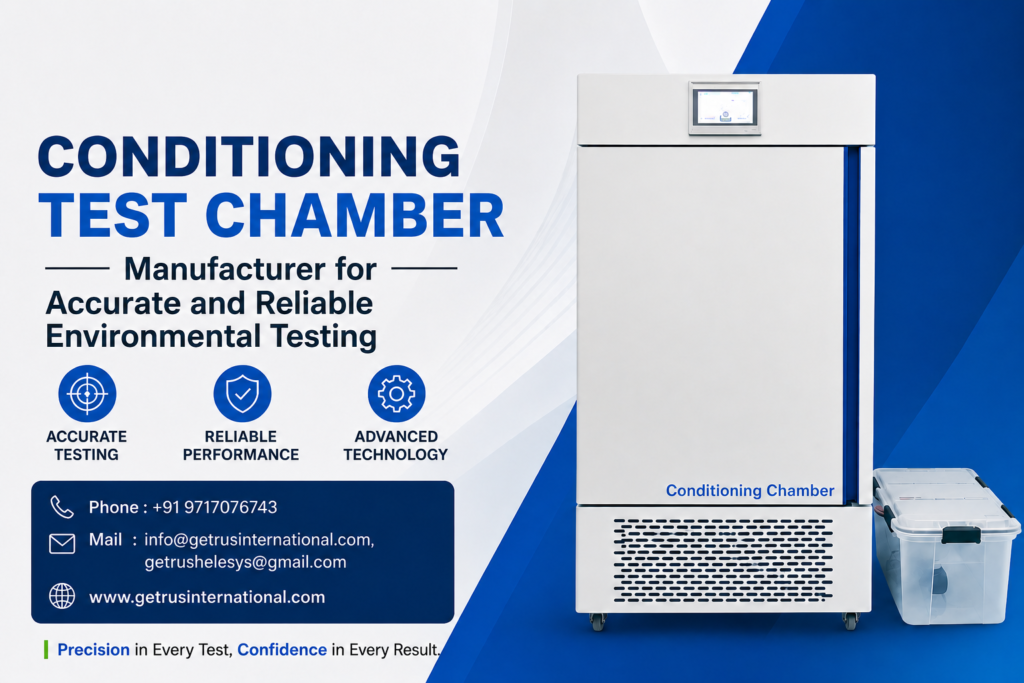
Laboratories and manufacturing facilities depend on consistent environmental conditions to generate test data that can actually be trusted. A single degree of temperature drift or a few percentage points of unexpected humidity can quietly skew results, sending a product to market without adequate validation or forcing a lab to repeat weeks of work. This is precisely the problem a conditioning test chamber is built to solve — and it’s why choosing the right conditioning test chamber manufacturer matters as much as the chamber itself.
Whether the application is pharmaceutical packaging, electronics, textiles, or automotive components, conditioning is the quiet first step that makes every downstream test meaningful. Get it wrong, and even the most sophisticated testing equipment further down the line is working with compromised samples. A test result is only as trustworthy as the sample that produced it, and that sample is only as reliable as the environment it was prepared in.
This is why procurement teams, quality managers, and lab directors spend so much time evaluating not just chamber specifications, but the manufacturer behind them. A chamber that drifts a few degrees off setpoint, or that distributes humidity unevenly across its interior, can quietly undermine months of otherwise careful testing work. Choosing the right partner up front saves that headache later.
What Is a Conditioning Test Chamber?
A conditioning test chamber is a controlled enclosure that brings materials, components, or finished products to a stable, defined temperature and humidity level for a set period of time before they are subjected to mechanical, electrical, or performance testing. It doesn’t run the actual test — it prepares the sample so that whatever test follows reflects the product’s true environmental behavior rather than the condition it happened to be in when it arrived at the lab.
This distinction matters more than it might seem. A cardboard carton, a plastic component, or a textile sample will absorb or release moisture depending on the surrounding air, and its mechanical properties change as it does. A laboratory conditioning chamber removes that variable by holding the sample at a known temperature and relative humidity until it reaches equilibrium, so that a compression test, a tensile test, or an electrical insulation check is measuring the product’s real-world performance rather than a random snapshot influenced by ambient room conditions.
Conditioning units of this kind are sometimes referred to as reach-in conditioning cabinets or pre-test environmental chambers, and they’re a standard fixture in quality-control departments across several industries.
It helps to think of conditioning as the “acclimatization” phase of testing. Just as a person arriving in a new climate needs time to adjust before their body performs normally, a material sample needs time in a stable, known environment before its properties settle into a predictable state. Skip this step, and the data collected afterward reflects a moving target rather than a fixed, comparable baseline. This is precisely why so many international test standards — covering packaging, plastics, textiles, and electronics — build a mandatory conditioning period directly into their testing procedures rather than leaving it as an optional best practice.
Why Accurate Environmental Conditioning Matters
The value of conditioning becomes clear the moment test results need to be defended — to a regulator, a customer, or an internal quality team.
Test consistency: Samples conditioned at the same temperature and humidity every time produce comparable, apples-to-apples results across batches and across time.
Product quality: Materials behave differently when they’re too dry, too damp, too warm, or too cold. Conditioning ensures quality checks are evaluating the product as it will actually perform in the field, not in an arbitrary lab state.
Material performance: Packaging, plastics, rubber, and textiles are all moisture- and temperature-sensitive. Their strength, flexibility, and dimensional stability shift with environmental exposure, so pre-test conditioning is often a prerequisite specified directly in the relevant test standard.
Repeatability: A test that can’t be repeated with the same outcome isn’t a reliable test. Controlled conditioning is one of the main variables that makes repeat testing possible.
Reliability of laboratory results: Auditors, certification bodies, and clients increasingly expect documented evidence that samples were conditioned correctly before testing began.
Understanding environmental effects on products: For products destined for humid coastal climates, high-altitude regions, or extreme temperature zones, conditioning chambers let engineers study how the product will actually hold up before it ever ships.
Beyond these individual benefits, there’s a broader reason conditioning has become non-negotiable in many quality systems: traceability. When an auditor or a client asks how a batch of samples was prepared, “we conditioned them at a documented temperature and humidity for a set duration, using calibrated equipment” is a defensible answer. “We tested them as they came off the production line” is not. In regulated or export-oriented industries especially, that difference can determine whether a product clears certification or gets sent back for retesting.
Key Features to Consider When Choosing a Conditioning Test Chamber
Not every chamber on the market is built for the same rigor. Buyers evaluating options should look closely at:
- Temperature control — accurate, stable heating with minimal overshoot, ideally with a digital controller offering fine-grained readability.
- Humidity control — a reliable humidity generation and monitoring system, since conditioning standards are frequently specified as a combined temperature-and-humidity setpoint.
- Uniform air circulation — forced-air circulation through blowers ensures every sample in the chamber, not just the ones near the sensor, experiences the same conditions.
- Insulation and build quality — a well-insulated, double-walled construction keeps internal conditions stable and reduces energy loss.
- Digital temperature/humidity monitoring — continuous, visible readouts make it easier to catch drift before it compromises a test.
- Safety alarms — audio-visual alerts for temperature overshoot, door-open events, or water-supply failure protect long, unattended conditioning cycles.
- Chamber construction — corrosion-resistant interiors and durable exteriors that can withstand repeated use in an industrial or lab setting.
- Sample visibility — a viewing window allows technicians to check on samples without opening the door and disturbing the internal environment.
- Customization requirements — different industries need different chamber sizes, shelf configurations, and controller logic; a one-size-fits-all chamber rarely fits every lab.
- Ease of operation and maintenance — accessible components for servicing, and controls that don’t require specialized training to operate correctly.
Buyers should only expect specific numerical performance claims when they’re backed by the manufacturer’s own documented specifications rather than generic marketing copy.
How to Choose the Right Conditioning Test Chamber Manufacturer
The chamber is only as good as the company standing behind it. Before signing off on a purchase, it’s worth evaluating a manufacturer on:
- Product quality — is the chamber built for continuous industrial or laboratory use, or is it a lighter-duty unit repackaged for a broader market?
- Customization capability — can the manufacturer adjust chamber size, shelving, controller type, and finish to match a specific test protocol?
- Technical expertise — does the team understand the testing standards the chamber needs to support?
- Manufacturing experience — an established manufacturing history usually translates into fewer design flaws and better long-term reliability.
- Application support — will the manufacturer help specify the right chamber for a particular material or industry, or just sell a standard catalog unit?
- Installation — is professional installation and commissioning included, or left entirely to the buyer?
- Calibration — can the manufacturer provide or support calibration services to keep the chamber within tolerance over time?
- Maintenance — is there a structured maintenance or AMC (Annual Maintenance Contract) option available?
- After-sales technical support — how accessible is the manufacturer once the chamber is installed and running?
- Delivery capability — can the manufacturer meet realistic timelines, especially for custom-built units?
Applications of Conditioning Test Chambers
Conditioning test chambers show up wherever a product’s real-world environmental behavior needs to be understood before or alongside performance testing:
- Pharmaceutical research and packaging — conditioning blister packs, closures, and packaging materials ahead of moisture-barrier and stability-related evaluations.
- Biotechnology and healthcare — preparing materials and components used in diagnostic and laboratory workflows under controlled conditions.
- Material testing — plastics, rubber, paper, and composite materials conditioned before dimensional or mechanical assessment.
- Industrial research — general R&D applications where environmental exposure needs to be simulated in a controlled, repeatable way.
- Automotive — conditioning rubber seals, adhesives, and plastic components before durability and fatigue testing.
- Aerospace — preparing components for environmental stress evaluation relevant to aviation-grade quality requirements.
- Textiles and other controlled-environment applications — conditioning fabric samples ahead of tensile and shrinkage testing.
The specific standard and duration used for conditioning always depends on the material and the governing test protocol, so labs should confirm requirements against the applicable standard rather than assuming a universal setpoint.
What ties these industries together is not the material being conditioned, but the underlying need: a controlled, repeatable starting point before a test begins. A pharmaceutical packaging lab and an automotive components supplier may be conditioning completely different materials for entirely different reasons, but both are relying on the same fundamental principle — that a stable, known environment produces test data that can actually be trusted and defended.
Why Work With an Experienced Conditioning Test Chamber Manufacturer?
There’s a meaningful difference between buying a chamber from a distributor reselling third-party units and working directly with a manufacturer that designs and builds in-house. An experienced manufacturer can offer:
- Custom-built equipment tailored to a specific test standard rather than a generic catalog size.
- Direct technical guidance from people who understand the engineering behind the chamber, not just the sales pitch.
- Tighter quality control, since design, fabrication, and testing all happen under one roof.
- Coordinated installation, calibration, and maintenance instead of juggling multiple vendors.
- Long-term support and spare-parts availability, which matters far more once the warranty period ends.
For labs planning a long-term investment — especially ones that may need repeat orders, spares, or larger walk-in installations down the line — that manufacturer relationship becomes an operational asset, not just a one-time purchase.
Getrus International: Laboratory and Environmental Testing Solutions
Getrus International is a manufacturer and supplier of laboratory and environmental testing equipment, with a product range that spans conditioning test chambers, clean-room equipment, autoclaves, IVF and IUI laboratory solutions, and broader environmental testing equipment. The company positions itself around in-house manufacturing, meaning chambers are designed and built internally rather than sourced from third parties and resold.
Its offering also extends into customized equipment solutions, along with installation, calibration, and maintenance support intended to keep equipment running accurately over its working life — services that matter as much as the initial build quality when a chamber is expected to perform consistently for years.
For organizations looking for reliable and application-specific environmental testing equipment, Getrus International offers conditioning test chambers and customized laboratory solutions designed around different testing requirements.
Labs and manufacturers evaluating a conditioning test chamber manufacturer for an upcoming project can review Getrus International’s full range of environmental testing and laboratory equipment at getrusinternational to see how their capabilities align with a specific testing standard or application.
Contact Getrus International :
Phone: +91 9717076743
Email: info@getrusinternational.com, getrushelesys@gmail.com
Manufacturing Unit: 2124 MIE part B, Bahadurgarh, Haryana 124507
Corporate Office: 1621-A G/F Mundka, New Delhi 110041