
Source: https://blog.saferhome.ai/my-safe-florida-home-grant-2026
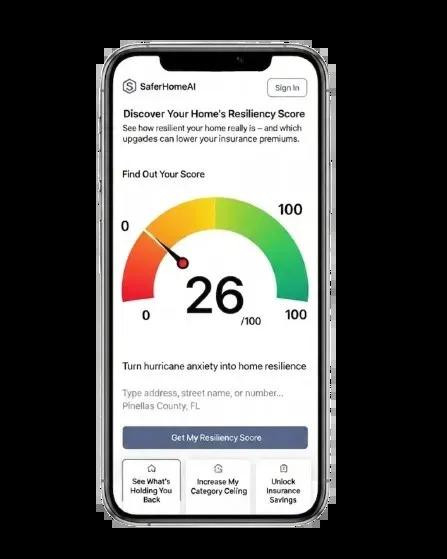
The My Safe Florida Home program is a state-funded initiative run by the Florida Department of Financial Services. It gives eligible homeowners matching grants — up to $10,000 — to pay for hurricane hardening upgrades on their primary residence. The Florida Legislature created the program to tackle the state’s home insurance affordability crisis head-on: by reducing the physical risk of storm damage, the program reduces the cost of insuring that home.
The process runs in two stages. First, the state sends out a free inspection to assess your home and pinpoint which upgrades would do the most to reduce hurricane risk. Second, once those upgrades are identified, a matching grant of up to $10,000 helps pay a registered contractor to complete them.
What makes the program particularly valuable is the compounding effect. The state helps pay for the upgrade, and that same upgrade then qualifies your home for mandatory wind mitigation insurance credits — savings that show up on your premium every single year afterward, not just once.
How Much Money Is Available?
There are two funding tiers, based on household income:
Standard Tier — up to $10,000, 1:1 match. For every dollar you put toward an eligible improvement, the state matches it, up to $10,000. Spend $10,000 and the state adds another $10,000, giving you $20,000 worth of hardening work.
Enhanced Tier — up to $12,000, no match required. Homeowners at or below 80% of their county’s Area Median Income may qualify for a grant of up to $12,000 with zero out-of-pocket match. The state covers the full cost.
Both tiers are grants, not loans — there’s no repayment obligation. Funding levels are set by the state budget each cycle, so it’s worth confirming current numbers before you apply.
Who Qualifies?
Eligibility is fairly straightforward, and most single-family Pinellas County homeowners meet the bar. You’ll generally qualify if:
- Your home is a single-family, site-built residence (attached or detached) — mobile homes, manufactured homes, and condos don’t qualify
- It’s your primary residence, not a rental or vacation property
- You’re located in the windborne debris region, which covers all of Pinellas County
- Your home’s insured value is $700,000 or under
- You carry active homeowner’s insurance through an authorized Florida insurer or Citizens
- You’re the owner of record on the property deed
- Your property hasn’t already received an MSFH grant in a prior cycle
Eligibility rules can shift between funding cycles, so double-check current criteria before you start an application.
What the Grant Actually Pays For
Your state inspector — not you or your contractor — determines which improvements your home qualifies for. The four categories the program funds are:
Opening protection — impact-resistant windows, exterior doors, skylights, and garage doors. This is the most commonly funded category and typically carries the biggest insurance credit.
Roof deck attachment — reinforcing how the roof sheathing is fastened to the trusses, usually done alongside a roof replacement.
Secondary water resistance — a sealed “peel and stick” barrier under the roofing that keeps water out if the outer layer is compromised.
Roof-to-wall connections — upgrading how the roof structure ties into the walls, from simple toe nails to reinforced clips or straps. This matters most for homes built before 2002.
One important catch: work only counts if it’s done by a contractor registered with the My Safe Florida Home program. Anything completed by a non-registered contractor won’t be reimbursed, no exceptions.
How to Apply, Step by Step
- Check that applications are currently open. The program runs in funding cycles and closes once the budget is exhausted, so verify status before investing time.
- Get a sense of your starting position. A wind mitigation or fortification assessment ahead of time helps you understand what your home is likely to need before the official inspection happens.
- Create an account and submit your application. You’ll need your property address, parcel number, insurance declarations page, photo ID, and proof of ownership. Low-income applicants should also gather income documentation for the enhanced tier.
- Schedule your free state inspection. Clear attic access beforehand — the inspector needs to check roof deck attachment and roof-to-wall connections from inside.
- Get at least two bids from registered contractors for each improvement the inspection identifies.
- Submit those bids for program approval, then wait. Do not start any work before you have written approval — doing so forfeits your reimbursement.
- Complete the work and submit for reimbursement, keeping every permit, invoice, certification, and receipt.
- Get a new wind mitigation inspection after the work is done. This produces the OIR-B1-1802 form your insurer needs to actually apply your premium discount. This last step is the one homeowners most often skip — and skipping it means missing out on the annual savings the whole program is designed to unlock.
The Financial Picture: Grant Plus Insurance Savings
The grant is worthwhile on its own, but the real value comes from stacking it with the annual insurance credits mandated under Florida Statute 627.0629.
Take a typical Pinellas County example: a homeowner spends $22,000 on impact windows across all openings. The $10,000 matching grant brings their net cost down to $12,000. That upgrade then triggers roughly a 28% reduction in the wind portion of their premium — about $1,400 a year. Over five years, that’s $7,000 in savings, bringing the effective net cost down to around $5,000, for a total value created of roughly $17,000. Stay in the home another decade, and the math tilts even further in the homeowner’s favor.
Why This Matters So Much in Pinellas County
Pinellas County sits entirely within the windborne debris region, carries some of the highest home insurance premiums in the state, and has a large share of housing built before the 2002 Florida Building Code. That combination — older construction, high premiums, and full program eligibility — makes it one of the highest-value markets in Florida for this program.
Pre-2002 homes in St. Petersburg, Clearwater, Largo, and Seminole typically still have gable roofs, toe-nail connections, and no opening protection, which means their free inspections tend to turn up multiple fundable improvements — putting these homeowners in a strong position to capture the full grant. Post-2002 homes that are already code-compliant but still lack impact windows are the next best fit, since opening protection stacks on top of an already-solid wind mitigation profile.
Frequently Asked Questions
Is the program open in 2026? Availability depends on state funding and changes cycle to cycle — check current status before applying.
What if I already have impact windows? The inspection only funds what it identifies as missing, so an improvement you’ve already made won’t be reimbursed — but other categories, like roof deck attachment or roof-to-wall connections, may still qualify.
Is this the same as a wind mitigation inspection? No. The MSFH inspection determines what the grant will fund. A separate, privately hired wind mitigation inspection afterward is what actually gets your insurer to apply the premium credit.
Is the grant taxable? In most cases, grants for primary-residence home improvements aren’t treated as taxable income, but confirm your specific situation with a tax professional.