
Most people hear “cold plunge” and immediately picture athletes dunking themselves in ice water after a brutal training session. It sounds extreme, maybe even masochistic. But what if the real story goes far beyond sore muscles and athletic recovery? What if stepping into cold water regularly could reshape your brain chemistry, protect your heart, improve your relationships, and even extend your life in ways that science is only beginning to understand?
Cold water immersion has been practiced for centuries across cultures, from the ancient Romans to the Nordic tribes. Today, it has surged back into popular conversation, appearing in wellness centers, high-performance gyms, and backyard setups alike. While most people focus on the muscle recovery angle, the deeper, lesser-known benefits are far more extraordinary. This article digs into ten surprising, research-backed advantages of cold plunging that you have almost certainly never heard of, and why they deserve your serious attention.
Section 1: The Brain and Mental Health Benefits Nobody Talks About
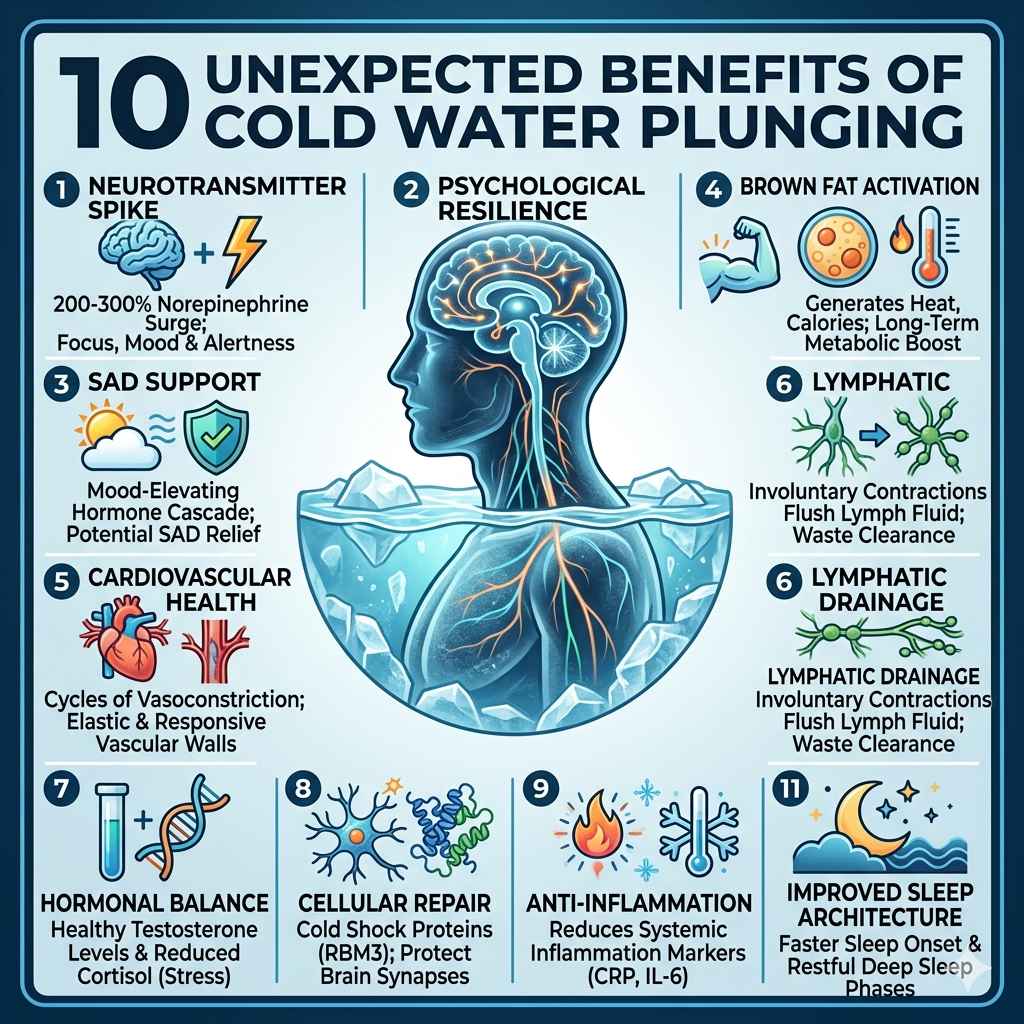
1. It Triggers a Norepinephrine Surge Larger Than Almost Any Legal Substance
When you immerse yourself in cold water, your brain releases norepinephrine, a neurotransmitter and hormone that plays a central role in focus, attention, and mood regulation. Research highlighted by neuroscientist Andrew Huberman shows that a single cold water immersion can increase norepinephrine levels by 200 to 300 percent, a spike that lasts for several hours after the session ends.
This is not a minor chemical nudge. This is a sustained, significant shift in your neurochemistry that rivals the effect of many pharmacological interventions, without any of the dependency risks. People who cold plunge regularly often report dramatically improved concentration, sharper mental clarity, and a heightened sense of calm alertness throughout the day. For those struggling with brain fog, low motivation, or mild depressive symptoms, this neurochemical response alone makes cold immersion worth exploring.
2. It Builds Genuine Psychological Resilience, Not Just Physical Toughness
There is a fundamental difference between being physically tough and being psychologically resilient. Physical toughness means enduring discomfort. Psychological resilience means choosing discomfort deliberately, staying regulated under stress, and emerging from hard experiences with a stronger sense of self-efficacy.
Cold plunging is one of the rare practices that trains this capacity directly. Every time you lower yourself into cold water while your brain screams at you to stop, you are rehearsing the skill of overriding panic, managing your breath, and staying present under duress. Over time, this translates powerfully into everyday life. Difficult conversations, high-stakes decisions, and stressful situations become more manageable because your nervous system has been trained to regulate itself under extreme conditions. This is not metaphorical. It is a real, trainable neurological skill.
3. It May Reduce Symptoms of Seasonal Affective Disorder
Seasonal Affective Disorder, a form of depression tied to reduced sunlight in winter months, affects millions of people worldwide. While light therapy is the most commonly recommended intervention, cold water immersion is emerging as a compelling complementary approach. The shock of cold water activates the sympathetic nervous system and produces an immediate mood-elevating cascade of hormones, including dopamine and serotonin precursors.
A case study published in the British Medical Journal documented a young woman who successfully managed her treatment-resistant depression primarily through regular cold water swimming, eventually reducing and eliminating her medication under medical supervision. While individual cases are not universal evidence, they reflect a pattern that researchers are now studying more systematically. The mood elevation that follows a cold plunge is not imaginary. It is biochemical, measurable, and consistent.
Section 2: Metabolic and Physiological Surprises
4. It Activates Brown Adipose Tissue for Long-Term Metabolic Benefits
Most people know about white fat, the stored energy that accumulates around the waist and organs. Fewer people know about brown adipose tissue, a metabolically active type of fat that generates heat by burning calories. Infants have large amounts of it. Adults retain smaller deposits, primarily in the neck, chest, and upper back.
Cold exposure is one of the most potent known activators of brown fat. When you regularly expose yourself to cold temperatures, your body actually increases the volume and activity of your brown adipose tissue, improving your baseline metabolic rate even when you are not in the water. This means cold plunging can contribute to more efficient energy use throughout the day, better insulin sensitivity, and improved glucose metabolism. For people concerned about metabolic health, type 2 diabetes risk, or stubborn weight management plateaus, this is a genuinely underappreciated mechanism.
5. It Strengthens the Cardiovascular System in a Unique Way
Cardiovascular exercise strengthens the heart by putting sustained demand on the system over time. Cold immersion strengthens it through a completely different mechanism: repeated cycles of vasoconstriction and vasodilation. When you enter cold water, your blood vessels constrict sharply to conserve core heat. When you exit, they dilate rapidly as blood rushes back to the extremities.
This cycle, repeated consistently over weeks and months, trains your vascular walls to become more elastic and responsive. Think of it as interval training for your circulatory system. Studies have associated regular cold water swimmers with lower resting blood pressure, improved heart rate variability, and reduced cardiovascular disease risk markers. The key is consistency. Occasional cold exposure produces acute benefits. Regular exposure produces structural, lasting changes to vascular health.
6. It Accelerates Lymphatic Drainage Without Exercise
The lymphatic system is your body’s internal waste removal and immune surveillance network. Unlike the cardiovascular system, it has no pump. It relies entirely on muscular contractions and body movement to push lymph fluid through its vessels. This is why sedentary lifestyles are associated with sluggish immune function, increased inflammation, and poor cellular waste clearance.
Cold water immersion creates rapid, involuntary muscle contractions throughout the entire body. This mechanical stimulation drives lymphatic fluid through the system far more forcefully than most gentle exercise forms. The result is accelerated clearance of cellular metabolic waste, improved delivery of immune cells to tissues, and a general reduction in systemic inflammation. For people who sit at desks all day, this benefit alone is remarkable.
Section 3: Hormonal and Longevity Advantages
7. It Boosts Testosterone and Reproductive Hormone Function
This benefit applies to both men and women, though it is most studied in men. Cold water immersion has been shown in multiple studies to support healthy testosterone levels by reducing the scrotal temperature in men (optimal testicular function requires temperatures slightly below core body temperature) and by lowering systemic cortisol, the stress hormone that directly suppresses testosterone production when chronically elevated.
For women, the hormonal benefits center on the reduction of chronic cortisol and its downstream effects on progesterone and estrogen balance. Chronically elevated cortisol is one of the primary hormonal disruptors in modern life, linked to irregular cycles, reduced fertility, and exacerbated perimenopausal symptoms. By creating a controlled, acute stress response followed by deep parasympathetic recovery, cold plunging effectively helps reset the hypothalamic-pituitary-adrenal axis, the master hormonal regulatory system of the body.
8. It Upregulates Cold Shock Proteins That Repair Cellular Damage
One of the most remarkable and least discussed benefits of cold exposure involves a class of molecules called cold shock proteins, most notably RNA-binding motif 3 (RBM3). These proteins are produced in response to cold temperatures and have been shown in research to trigger synaptic repair in the brain, protect neurons from degeneration, and support the preservation of cognitive function.
Emerging research from the University of Cambridge suggests that cold shock proteins may play a meaningful role in protecting against neurodegenerative conditions such as Alzheimer’s and Parkinson’s disease. While the field is still young and more human trials are needed, the mechanistic pathway is well established: cold exposure produces cold shock proteins, cold shock proteins repair and protect neural synapses. This is a longevity benefit that operates at the molecular level, far beneath what most wellness conversations ever reach.
9. It Reduces Chronic Inflammation at the Systemic Level
Chronic low-grade inflammation is now recognized as the common thread linking virtually every major age-related disease, from cardiovascular disease and type 2 diabetes to certain cancers and neurodegenerative conditions. Unlike acute inflammation (which is protective and necessary), chronic inflammation represents a persistent, dysregulated immune state that slowly damages tissues over years.
Cold water immersion consistently reduces markers of chronic inflammation, including C-reactive protein, interleukin-6, and tumor necrosis factor alpha. It does this by activating the diving reflex and the vagus nerve, triggering a powerful parasympathetic response that downregulates inflammatory signaling across multiple organ systems. People who use cold plunge tubs regularly as part of their wellness routine often report a general reduction in joint pain, improved skin clarity, and better digestive health, all of which are downstream effects of systemic inflammation reduction.
Section 4: Social, Behavioral, and Lifestyle Benefits
10. It Dramatically Improves Sleep Architecture
Sleep quality is perhaps the most underrated pillar of human health. While most people know they need more sleep, far fewer understand that the architecture of sleep matters as much as the duration. Deep slow-wave sleep and REM sleep serve fundamentally different restorative functions, and disruptions to these phases have serious long-term consequences.
Cold plunging in the late afternoon or early evening produces a powerful effect on core body temperature regulation that enhances sleep onset and depth. The body’s natural signal for sleep initiation is a drop in core temperature. Cold immersion accelerates this drop, essentially giving the body a running start toward its nighttime cooling process. Users of commercial cold plunge systems consistently report faster sleep onset, more vivid and restful dreams, and waking feeling genuinely refreshed rather than groggy. This improvement in sleep architecture has cascading benefits for mood, cognitive performance, hormonal regulation, immune function, and cardiovascular health.
Conclusion: The Coldest Decision You Can Make for Your Health
The benefits outlined above are not wellness trends or motivational talking points. They are the product of measurable physiological mechanisms, supported by a growing body of scientific research. Cold plunging works by triggering a cascade of adaptive responses in your nervous system, endocrine system, vascular system, and cellular machinery, responses that your body evolved over hundreds of thousands of years to produce in response to environmental cold exposure.
The modern challenge is that most of us have engineered cold almost entirely out of our lives. We live in climate-controlled homes, drive heated cars, wear insulating clothing year-round, and rarely allow our bodies to experience the mild thermal stress that once shaped our physiology. Cold plunging is, in many ways, a deliberate return to the conditions under which human biology thrives.
Whether you start with a simple cold shower at the end of your morning routine, invest in an ice bath at home, or explore professional options at a wellness facility, the entry point does not need to be dramatic. Start with 30 to 60 seconds of cold water exposure. Build gradually. Be consistent. Pay attention to how you think, feel, sleep, and move in the days and weeks that follow.