
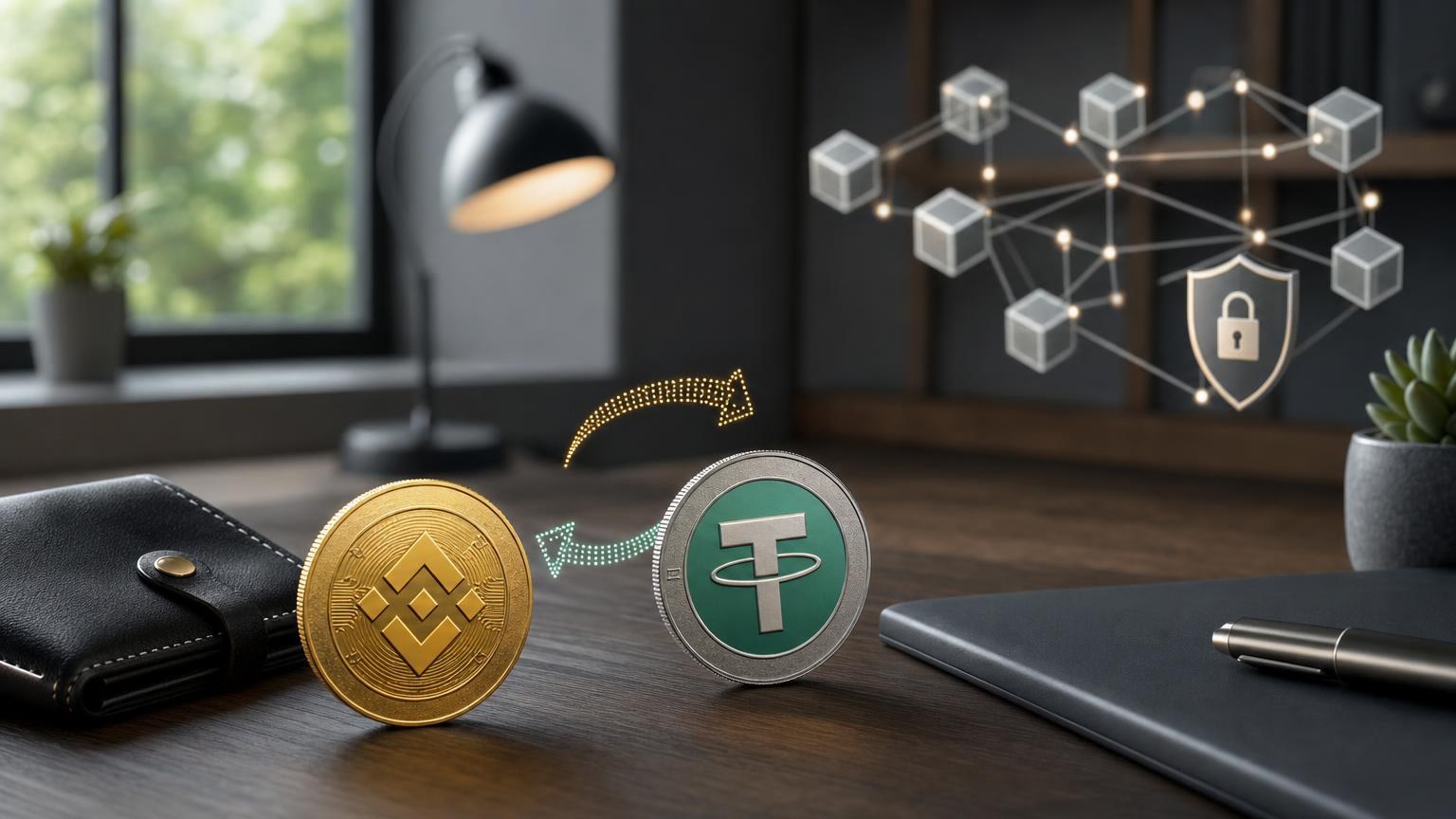
Exchanging BNB for USDT involves two separate decisions: the conversion itself and the blockchain on which the USDT will be delivered. The second decision is often more consequential. A favorable quote cannot compensate for sending tokens through a network that the receiving wallet, exchange, or payment platform does not support.
The correct comparison is therefore not simply “BNB versus USDT.” It is a comparison of complete routes: the network used to deposit BNB, the network used to receive USDT, the recipient’s technical requirements, and the assets needed to move the resulting USDT later.
What Is Actually Being Compared?
BNB is the asset being sold, while USDT is the asset being received. The exchange service may perform a same-chain conversion or settle the output on another blockchain. For example, a user may deposit BNB through BNB Smart Chain and request USDT on Ethereum or Tron, provided that this exact direction is currently available.
A cross-network exchange does not mean that BNB is being sent directly over Ethereum or Tron. The service receives BNB through its specified deposit network and separately sends USDT through the selected output network. This distinction prevents a common mistake: choosing the network according to the input asset rather than according to the destination’s deposit instructions.
The realistically comparable output routes are:
- USDT on BNB Smart Chain: a BEP-20-compatible route intended for wallets and platforms that explicitly support the relevant USDT token on BSC.
- USDT on Ethereum: the ERC-20 route for destinations that accept the Ethereum USDT contract and require settlement on Ethereum.
- USDT on Tron: the TRC-20 route for destinations that explicitly provide a Tron USDT deposit address.
These routes are comparable only when the exchange service currently offers them and the final recipient supports them. Availability, rates, service fees, network fees, limits, compliance requirements, and processing times are dynamic and must be checked when creating the order.
Stop Criteria: When a Route Must Be Rejected
Some conditions should end the comparison immediately. If any of the following checks fail, a lower estimated fee or familiar network name is irrelevant.
- The BNB deposit network is unsupported. Send BNB only through the network named in the order. BNB Beacon Chain cannot be treated as a current alternative: it was shut down in December 2024, and legacy BEP-2 holdings require a separate recovery process rather than a normal transfer route. [1]
- The recipient does not accept the selected USDT network. “USDT” alone is not sufficient confirmation. The destination must explicitly identify BNB Smart Chain, Ethereum, Tron, or another supported protocol.
- The token contract or asset identifier does not match. Shared symbols are not proof that two tokens are interchangeable at a specific deposit address. This is particularly relevant on smart-contract networks where multiple assets may use the same ticker.
- The exchange direction is unavailable. Support for BNB and USDT as separate assets does not prove that every network combination or trading direction is active.
- The destination cannot credit the token automatically. A wallet may technically control an address without displaying the asset, while a custodial platform may reject or fail to credit deposits made through an unsupported network.
- You cannot satisfy the current verification requirements. Required checks may depend on the direction, transaction details, and compliance results. They should be reviewed before funds are sent.
- You need to move the received USDT but lack the network’s gas asset. Subsequent self-custody transfers generally require BNB on BSC, ETH on Ethereum, or TRX or network resources on Tron. BSC transactions use BNB for gas, Ethereum fees are paid in ETH, and Tron smart-contract transfers consume Energy and Bandwidth, with TRX burned when available resources are insufficient. [2]
Constraint-Driven Decision Matrix
| Criterion | Meaning for the Exchange | Routes That Pass or Fail | Material Limitation | What to Verify Before Choosing |
|---|---|---|---|---|
| BNB deposit network | The sender must transfer BNB using the exact network assigned to the order. | BNB Smart Chain passes when the order provides a BSC deposit address. Legacy BNB Beacon Chain must be rejected as a normal deposit route. | A familiar-looking address does not override the network specified by the service. | Deposit network name, address, minimum amount, required confirmations, and whether any additional identifier is requested. |
| Recipient requires BNB Smart Chain | The output must be USDT in the precise BEP-20-compatible form accepted by the destination. | The BSC output route passes. Ethereum and Tron fail even if the recipient address was generated by a multi-chain wallet. | BSC can contain pegged or third-party representations of assets. The symbol “USDT” is not enough; contract compatibility matters. | Destination’s network label, accepted contract, deposit status, and current availability of the BNB-to-USDT BSC direction. |
| Recipient requires Ethereum | The service must settle the output as ERC-20 USDT on Ethereum. | Ethereum passes. BSC and Tron fail for an Ethereum-only deposit. | Ethereum transfers require ETH for gas when the USDT is later sent from a self-custody wallet. Fees vary with network demand. [3] | Official USDT contract, deposit availability, estimated output, service fee, network fee, and whether the wallet has ETH for later use. |
| Recipient requires Tron | The output address and settlement protocol must both be TRC-20. | Tron passes. Ethereum and BSC fail for a TRC-20-only destination. | A later USDT transfer consumes Tron network resources; insufficient Energy or Bandwidth can result in TRX being used for fees. [4] | TRC-20 deposit status, address format, accepted USDT contract, output amount, and access to TRX or sufficient network resources. |
| Destination accepts several networks | The decision can move beyond compatibility to total cost, operational convenience, and the intended next transaction. | Every currently available and explicitly supported route remains under consideration. | Network fee alone does not determine the final amount. The exchange rate, service fee, withdrawal charge, and any later transfer cost may change the result. | Final amount to be received, quote validity, all displayed charges, network status, and the cost of the next planned transfer. |
| USDT will remain in self-custody | The chosen wallet must support the network and the exact token, not merely the USDT ticker. | A route passes only if the wallet can display, receive, and later send that version of USDT. | Ethereum-compatible addresses on BSC and Ethereum can look similar, which can conceal a network mismatch rather than prevent it. | Active wallet network, token contract, gas balance, backup access, and explorer support. |
| USDT is being deposited to an exchange or payment service | The receiving platform’s deposit page is the source of truth for network selection. | Only the network shown as active for that specific USDT deposit passes. | Custodial platforms may not recover an unsupported-network deposit even when the address exists on another chain. | Current deposit notice, minimum credit amount, required confirmations, maintenance status, and any account-specific restrictions. |
| Compliance or regional restriction applies | The order may require checks or may be unavailable depending on the direction and compliance result. | Only routes for which the user can complete the displayed requirements pass. | Requirements can differ by transaction and jurisdiction; blockchain compatibility does not guarantee service eligibility. | Current verification request, applicable local rules, order terms, and the procedure if a transaction is paused for review. |
How the Main Network Routes Differ
BNB Smart Chain Output
BNB Smart Chain is an EVM-compatible smart-contract network. Its mainnet uses chain ID 56, and BNB is the native gas asset. BEP-20 defines the commonly used fungible-token format on the network. [5]
This route is a direct operational fit when the recipient explicitly asks for USDT on BSC. It may also reduce the need to maintain a second ecosystem if the user already manages BNB and BSC applications. That convenience does not establish that the route is universally cheaper or faster; current network conditions and the exchange’s quote still control the actual outcome.
The main limitation is token identity. Tokens on BSC may be native to a project, bridged, or issued as pegged representations. Before withdrawing to a self-custody wallet or depositing to another platform, compare the accepted contract rather than relying on the ticker or an automatically detected token name.
Ethereum Output
USDT on Ethereum uses the ERC-20 model, under which a smart contract tracks token balances and transfers. Ethereum transactions and contract interactions require gas paid in ETH, and the fee changes with network demand and the computational work involved. [6]
Ethereum is the necessary choice when the recipient accepts only ERC-20 USDT or when the funds are intended for an Ethereum-based application that requires this version of the token. Choosing BSC merely because the input asset is BNB would fail that requirement.
A practical constraint appears after receipt. A wallet holding ERC-20 USDT but no ETH may be unable to send the tokens until ETH is added for gas. The relevant cost comparison therefore includes not only the initial exchange but also the next action planned for the USDT.
Tron Output
TRC-20 is Tron’s smart-contract token standard, and Tether publishes a specific USD₮ contract for Tron. Tron processes transactions through a resource model involving Bandwidth and, for smart-contract operations such as TRC-20 transfers, Energy. [4]
This route fits a destination that explicitly provides a TRC-20 USDT address. It does not fit an Ethereum or BSC deposit, even if the intended account owner is the same.
The operational detail to plan for is the resource model. A user may need TRX when available Bandwidth or Energy does not cover a later transfer. The amount required is dynamic and should be estimated through the wallet or current network tools rather than assumed from an old transaction.
Why There Is No Universal Best Network
Changing one hard constraint can reverse the decision:
- The recipient accepts only BEP-20 USDT: BSC is the only eligible route. Ethereum and Tron are eliminated before costs are compared.
- The recipient is an Ethereum application: ERC-20 becomes mandatory. A potentially lower fee elsewhere has no value because the token would arrive on the wrong blockchain.
- The recipient provides only a TRC-20 address: Tron is required, subject to the exchange direction being available.
- All three networks are accepted: compare the actual USDT output, displayed charges, network status, quote validity, and the gas asset needed for the next transfer.
- The user already holds gas on one network: that route may be more practical for self-custody, but only after recipient compatibility and total exchange cost have been confirmed.
The network decision is therefore constraint-driven. Compatibility determines which routes remain possible; current economic and operational data decide between those remaining routes.
Before sending BNB, check the currently available BNB-to-USDT routes and their network requirements. Asset support does not imply that every pair, output network, or direction is active at a given moment.
Step-by-Step Exchange Process
- Obtain the destination requirements first. Open the recipient wallet or platform and select USDT deposit. Record the exact network and, where available, the accepted token contract.
- Select BNB as the input and USDT as the output. Confirm that the exchange offers the required output network rather than choosing a route solely by its name or estimated fee.
- Enter the receiving address carefully. Copy it directly from the destination. Check the beginning and end of the address, the selected network, and any warning shown by the recipient.
- Review the live order terms. Inspect the quoted amount, rate type, quote validity, fees, limits, expected confirmation policy, and current verification conditions. These values are dynamic.
- Use only the BNB deposit network specified in the order. Do not substitute another network because the wallet presents the same asset symbol.
- Send the instructed amount. Account for any withdrawal fee charged by the wallet or sending platform so that the service receives an amount that satisfies the order terms.
- Save the transaction hash and order details. A blockchain explorer can show whether the deposit was broadcast and confirmed, while the order page shows the service-side status.
- Verify the output on the correct explorer. Check BSC output through a BSC explorer, Ethereum output through an Ethereum explorer, or Tron output through a Tron explorer.
Final Pre-Transfer Checklist
- The BNB deposit network exactly matches the order.
- The destination explicitly supports the selected USDT network.
- The destination accepts the same token contract or asset identifier.
- The address was copied rather than typed manually.
- The exchange direction is currently available.
- The expected received amount and every displayed charge have been reviewed.
- The order limits and quote validity have been checked.
- Any required verification can be completed before the order expires.
- The recipient is not undergoing deposit maintenance for that network.
- A small test transaction has been considered where the service terms and minimum amounts make one practical.
- The wallet will have BNB, ETH, or TRX/resources if the received USDT must later be moved.
- The website and order page have been checked for phishing indicators before funds are sent.
Blockchain transfers are generally irreversible, and recovery after a wrong-network or wrong-address transfer may be impossible or dependent on the recipient’s technical capabilities. The safest route is not the one with the most familiar label; it is the currently available route that matches the recipient’s network, token contract, and planned use of the USDT without requiring an unsupported cross-chain step.