
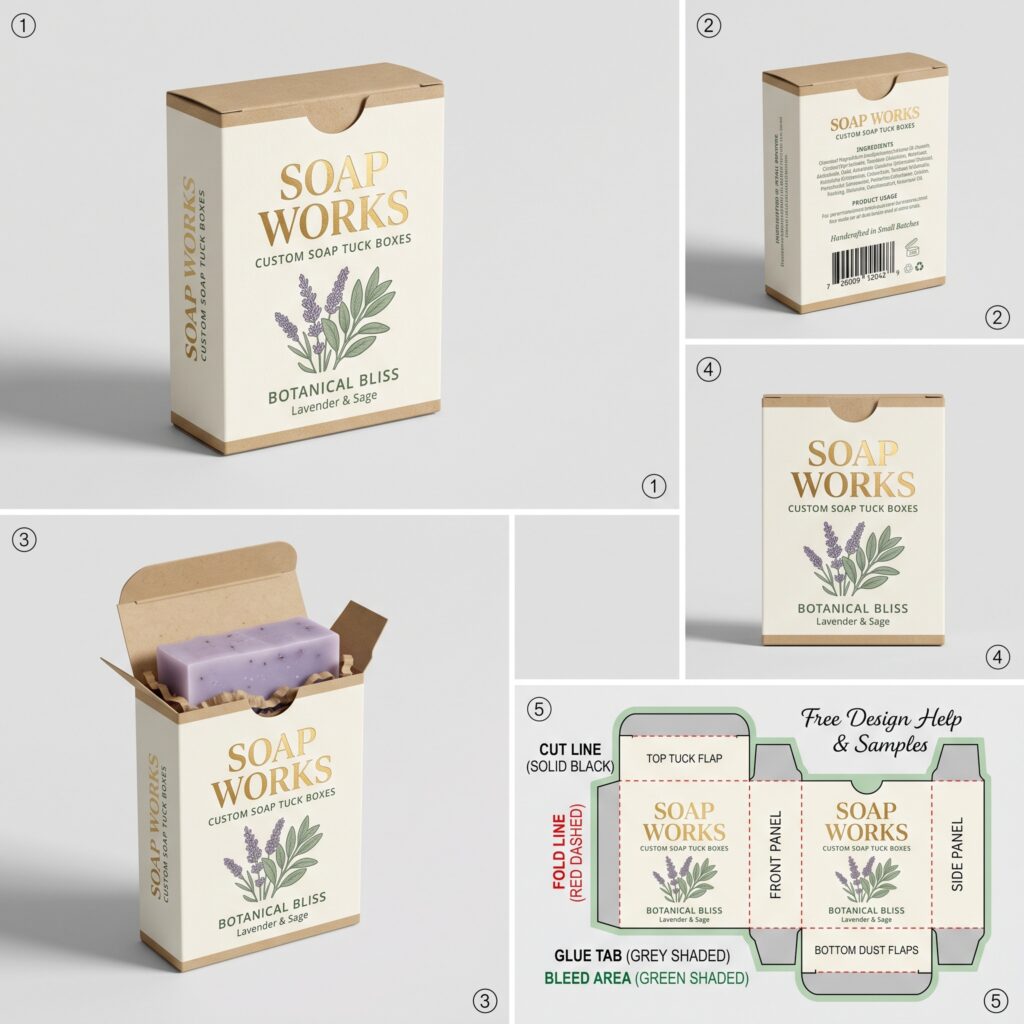
Packaging is the line item that surprises new soap businesses most. Ingredient costs are predictable. Labor is predictable. Packaging arrives as a single large invoice that has to be paid before you’ve sold anything.
Understanding where that money goes makes it much easier to control.
The four cost drivers
Setup costs. Every print job requires plates or press setup, and a custom die requires a cutting tool. These are one-time costs per design, and they don’t shrink with volume. This is the single biggest reason small orders feel expensive per unit you’re absorbing the same setup across far fewer boxes.
Material. Board stock, quantified by thickness and type. Real, but usually a smaller share of the total than people assume at small volumes.
Print complexity. Number of colors, whether you’re using process (CMYK) or spot (Pantone) inks, and whether the print covers the full surface or a small area. Full-bleed dark colors cost more than a light design with white space.
Finishing. Lamination, spot UV, foil stamping, embossing, die-cut windows. Each is a separate pass through separate equipment, and each adds meaningfully to the unit cost.
Why the per-unit price drops so sharply with volume
Here’s the shape of it. If your setup cost is fixed at, say, $400 and your per-box material and print cost is $0.18:
- 250 boxes → $1.78 each
- 1,000 boxes → $0.58 each
- 5,000 boxes → $0.26 each
That’s not a supplier being generous at volume. It’s arithmetic. The setup cost is being spread thinner.
This is why the advice “order more to save money” is technically true and practically dangerous. Ordering 5,000 boxes to get a good unit price is only smart if you will actually sell 5,000 units before the design changes. Small makers frequently rebrand, adjust their line, or discontinue scents within a year. Boxes for a discontinued scent are worth nothing.
The realistic strategy for small volumes
Use one box, differentiate with labels. Print a single unbranded-by-scent box in volume, then apply a small printed label or sticker to identify each variety. Your box economics improve dramatically, and labels are cheap to print in short runs. This is how a surprising number of established brands handle a twelve-scent line.
Skip finishing on your first run. Foil and spot UV are wonderful. They are also the easiest thing to add later once you know a design is working. Launch clean, add finishing on the reorder.
Design within standard dielines. A custom structural shape requires a custom die. Standard tuck-end and sleeve formats use existing tooling, which removes that cost entirely. Most soap boxes do not need a bespoke structure to look good.
Ask about digital printing at low quantities. Digital print has no plate setup, which makes short runs far more viable. The tradeoff is slightly less color consistency and a higher per-unit cost at scale. For a first run of a few hundred, it’s often the right call, and suppliers like Printed Soap Boxes and other packaging specialists in the category will usually quote both options if you ask.
What to actually ask for in a quote
Vague quotes hide cost. When you request pricing, specify:
- Exact finished dimensions (length × width × depth, in inches or mm)
- Board type and thickness
- Number of print colors and which surfaces print
- Any finishing required
- Three quantity tiers, so you can see the curve
- Whether the quote includes setup, die, shipping, and proofing
Then ask for the same spec from three suppliers. Quotes that differ by more than about 30% usually differ because someone quoted a different spec, not because someone is cheaper.
The number that actually matters
Not cost per box. Cost per soap box as a percentage of your retail price.
For handmade soap in the $8–$14 range, packaging landing somewhere between 5% and 12% of retail is normal and sustainable. Below 5% and you’re likely underinvesting in something customers can see. Above 15% and the packaging is eating margin you need elsewhere.
Work backward from that ratio and the right specification usually becomes obvious.